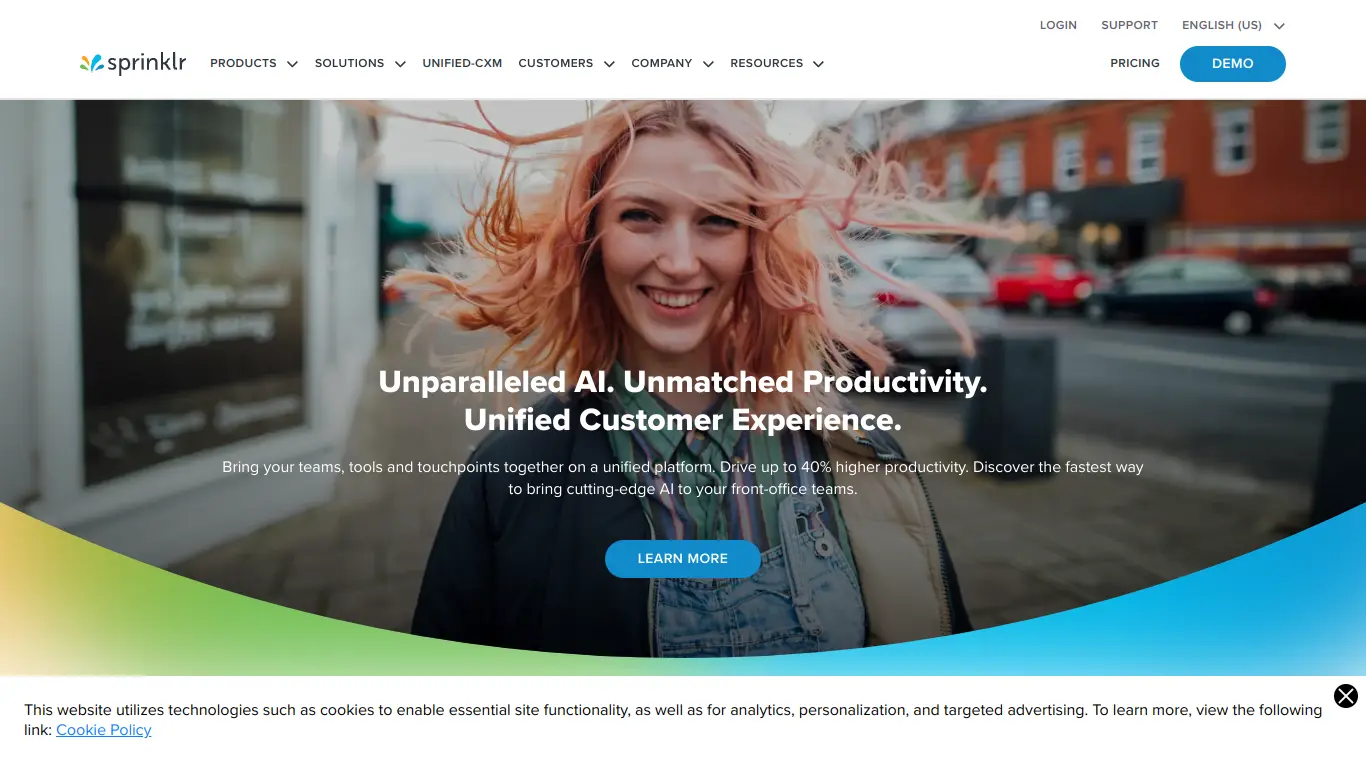
Sprinklr is an AI-powered platform that unifies marketing, advertising, research, care, and engagement for enterprise-level customer experience management.
Introduction to Sprinklr
Brands face an overwhelming challenge—managing countless customer interactions across dozens of channels while maintaining a consistent voice and delivering personalized experiences. If you’re struggling to unite your marketing, advertising, research, care, and engagement efforts, you’re not alone. The fragmentation of customer experience management has become a critical pain point for enterprises worldwide.
Enter Sprinklr, a unified customer experience management (Unified-CXM) platform that’s transforming how the world’s largest brands connect with their customers. Let’s dive into this comprehensive platform that promises to solve the complex puzzle of modern customer engagement.
What is Sprinklr and its Purpose?
Sprinklr is an AI-powered, unified customer experience management (Unified-CXM) platform designed to help enterprises manage customer-facing functions across all modern channels. Founded in 2009, Sprinklr has evolved from a social media management tool into a comprehensive suite that addresses five core aspects of customer experience:
- Modern Marketing: Content production, campaign management, and performance analytics
- Modern Advertising: Paid media planning, execution, and optimization
- Modern Research: AI-powered consumer and market intelligence
- Modern Care: Omnichannel customer service
- Modern Engagement: Social media management and community engagement
The platform’s primary purpose is to break down the silos between different customer-facing teams and channels, creating a unified view of the customer and enabling consistent, personalized experiences at scale.
Who is Sprinklr Designed For?
Sprinklr is specifically built for large enterprise organizations with complex customer experience needs. Its ideal users include:
- Global enterprises managing multiple brands across numerous markets
- Consumer-facing companies with high volumes of customer interactions
- Organizations with mature digital transformation initiatives seeking to unify their approach
- Multi-departmental teams spanning marketing, customer service, research, and advertising
While technically any business could benefit from Sprinklr’s capabilities, the platform’s depth and breadth are most valuable to organizations with substantial customer interaction volumes and complex organizational structures. Some of Sprinklr’s notable clients include Microsoft, P&G, L’Oréal, Prada, Cisco, and Samsung.
Getting Started with Sprinklr: How to Use It
Getting started with Sprinklr involves several key steps:
- Needs Assessment: Work with Sprinklr’s team to identify which modules (Marketing, Advertising, Research, Care, or Engagement) align with your organization’s goals.
- Implementation Planning: Develop a rollout strategy that considers your existing tech stack, team structure, and business objectives.
- User Setup and Training: Configure user roles, permissions, and workflows, then train team members on their specific modules.
- Channel Connection: Integrate your social media accounts, messaging platforms, review sites, and other customer-facing channels.
- AI Configuration: Customize Sprinklr’s AI to recognize your brand voice, product terminology, and customer sentiment patterns.
The implementation process typically takes several weeks to months, depending on the complexity of your organization and the number of modules deployed. Sprinklr provides dedicated onboarding specialists and training resources to support the transition.
Sprinklr’s Key Features and Benefits
Core Functionalities of Sprinklr
Sprinklr’s unified platform includes an impressive array of capabilities across its five product suites:
🔹 Sprinklr Marketing
- Content planning and creation with AI assistance
- Asset management with smart tagging
- Campaign management across 30+ digital channels
- Real-time performance analytics
- Compliance and approval workflows
🔹 Sprinklr Advertising
- Cross-channel ad planning and buying
- Budget optimization with AI recommendations
- Creative asset management
- Audience targeting and segmentation
- Performance measurement and attribution
🔹 Sprinklr Research
- AI-powered social listening and competitive intelligence
- Brand health monitoring
- Product and campaign insights
- Customer sentiment analysis
- Trend identification and forecasting
🔹 Sprinklr Care
- Omnichannel case management
- AI-powered routing and prioritization
- Agent productivity tools
- Self-service options with chatbots
- CSAT and quality management
🔹 Sprinklr Engagement
- Social media publishing and scheduling
- Community management across platforms
- Influencer identification and management
- Crisis detection and management
- Engagement analytics and reporting
At the heart of these functionalities is Sprinklr’s proprietary AI engine, which powers everything from content recommendations to sentiment analysis and automated workflows.
Advantages of Using Sprinklr
The benefits of implementing Sprinklr include:
1. Unified Customer View: By consolidating data from all customer touchpoints, Sprinklr eliminates fragmented views and provides comprehensive customer insights.
2. Operational Efficiency: Teams spend less time switching between tools and more time creating value. Automation handles routine tasks, freeing human resources for complex work.
3. Consistent Brand Experience: With centralized content management and shared customer context, brands can maintain consistency across all channels and departments.
4. Data-Driven Decision Making: Real-time analytics and AI-powered insights enable more informed strategic choices and faster course corrections.
5. Scale and Agility: Enterprise-grade infrastructure handles massive volumes of interactions while remaining flexible enough to adapt to changing market needs.
6. Reduced Technology Costs: Consolidating multiple point solutions into one platform typically leads to significant cost savings.
Main Use Cases and Applications
Sprinklr supports numerous customer experience scenarios:
| Use Case | Application | Key Benefits |
|---|---|---|
| Omnichannel Customer Service | Managing inquiries across social, messaging, email, and chat | Reduced response times, consistent service quality |
| Integrated Marketing Campaigns | Coordinating content across social, web, email, and ads | Cohesive messaging, efficient resource use |
| Social Listening & Market Research | Analyzing conversations about brands, products, and competitors | Proactive issue detection, competitive insights |
| Crisis Management | Monitoring and responding to emerging PR issues | Faster response times, coordinated messaging |
| Influencer Marketing | Identifying, engaging, and measuring influencer partnerships | Improved targeting, better ROI measurement |
| Regulatory Compliance | Ensuring content meets industry regulations | Reduced compliance risks, audit trails |
| Voice of Customer Programs | Collecting and analyzing customer feedback | Actionable product insights, service improvements |
Exploring Sprinklr’s Platform and Interface
User Interface and User Experience
Sprinklr’s interface is sophisticated yet intuitive, designed to manage complex workflows while remaining accessible to users with varying technical expertise.
Key UI/UX elements include:
- Customizable Dashboards: Users can configure their view to prioritize the metrics and activities most relevant to their role.
- Smart Inbox: A unified feed of all customer interactions requiring attention, with AI-powered prioritization.
- Command Center: Visual displays of real-time data for collaborative monitoring and decision-making.
- AI Assistant: Contextual recommendations that suggest responses, identify trends, and highlight opportunities.
- Workflow Builder: A visual tool for creating custom processes across teams and channels.
The platform follows a consistent design language across modules, which helps users navigate between different functions without a steep learning curve. Color coding, iconography, and information hierarchy are thoughtfully implemented to manage the complexity inherent in enterprise software.
Platform Accessibility
Sprinklr is a cloud-based SaaS platform accessible primarily through:
- Web Application: The primary interface for daily operations, compatible with modern browsers
- Mobile Apps: iOS and Android applications for on-the-go management
- APIs and SDKs: For custom integrations with existing systems
- Browser Extensions: For social media monitoring and engagement without leaving third-party sites
The platform supports role-based access controls, allowing organizations to precisely manage what users can view and modify. This is particularly important for enterprises with complex organizational structures and compliance requirements.
Sprinklr also offers accessibility features compliant with WCAG guidelines, ensuring users with disabilities can effectively use the platform.
Sprinklr Pricing and Plans
Subscription Options
Sprinklr utilizes an enterprise pricing model tailored to each organization’s specific needs. While the company doesn’t publish standard pricing on its website, the subscription structure is based on several factors:
- Modules Selected: Which of the five product suites you implement
- User Seats: The number of employees accessing the platform
- Volume Metrics: Such as social profiles managed, message volume, or ad spend
- Implementation Services: Including configuration, training, and integration
- Support Level: Basic, premium, or dedicated support options
Contracts typically run on annual or multi-year terms, with enterprise clients often negotiating custom agreements based on their specific requirements.
Free vs. Paid Features
Sprinklr does not offer a true freemium model, but provides several options for organizations to explore the platform before committing:
- Product Demos: Customized demonstrations focusing on specific use cases
- Pilot Programs: Limited-scope implementations to prove value before full deployment
- ROI Assessments: Consultative engagements to quantify potential benefits
- Free Resources: Whitepapers, webinars, and best practice guides
For organizations ready to implement Sprinklr, the entry point typically starts with one primary module (such as Engagement or Care) with the option to expand to additional modules as needs evolve.
Sprinklr Reviews and User Feedback
Pros and Cons of Sprinklr
Based on user reviews across G2, Capterra, and TrustRadius, here’s how users evaluate Sprinklr:
Pros:
- Comprehensive coverage of all social and messaging channels
- Powerful AI capabilities for automation and insights
- Robust workflow management for large teams
- Extensive customization options
- Strong enterprise-grade security and compliance features
- Continuous innovation and regular platform updates
Cons:
- Steep learning curve due to platform complexity
- Higher price point compared to point solutions
- Implementation can be time-consuming
- Some users report occasional performance issues with high data volumes
- Advanced customization often requires professional services support
User Testimonials and Opinions
Marketing Executive at a Fortune 500 Retailer:
“Sprinklr has transformed our social customer care from a reactive necessity to a proactive advantage. We’ve reduced response times by 60% while handling 3x the volume with the same team size.”
Digital Transformation Director at a Global CPG Company:
“The biggest value we’ve seen is breaking down silos between our marketing, care, and insights teams. Now everyone works from the same data, speaks the same language, and delivers consistent experiences to our consumers.”
Social Media Manager at a Technology Company:
“The learning curve was steep, but once our team got comfortable with the platform, we couldn’t imagine going back to our previous tools. The automation alone saves each team member about 10 hours per week.”
Customer Experience Leader at a Financial Services Firm:
“Implementation took longer than expected, but Sprinklr’s professional services team was excellent throughout the process. The ROI became clear within the first six months as we consolidated five separate tools into one platform.”
Sprinklr Company and Background Information
About the Company Behind Sprinklr
Sprinklr was founded in 2009 by Ragy Thomas, who recognized the need for enterprises to manage the emerging landscape of social media engagement. What began as a social media management tool has evolved into a comprehensive customer experience management platform.
Key company facts:
- Headquarters: New York, NY
- Global Presence: Offices in 25 countries serving customers worldwide
- Employees: Approximately 3,000+ employees globally
- Funding: Raised over $400 million in venture funding before going public
- IPO: Listed on the New York Stock Exchange (NYSE: CXM) in June 2021
- Leadership: Ragy Thomas continues to serve as CEO and Chairman
Sprinklr has grown both organically and through strategic acquisitions, including Dachis Group (social marketing), Nanigans (advertising), and Lithium Technologies (community management).
The company’s mission is “to enable every organization on the planet to make their customers happier,” reflecting its focus on improving customer experience through unified technology.
Sprinklr Alternatives and Competitors
Top Sprinklr Alternatives in the Market
While Sprinklr offers a uniquely comprehensive platform, several alternatives exist for organizations considering other options:
- Khoros (https://khoros.com/): Strong in community management and customer engagement
- Hootsuite Enterprise (https://www.hootsuite.com/): Focused on social media management
- Salesforce Marketing Cloud (https://www.salesforce.com/products/marketing-cloud/): CRM-centric marketing platform
- Adobe Experience Cloud (https://business.adobe.com/products/experience-cloud/): Creative and experience-focused platform
- Zendesk Suite (https://www.zendesk.com/): Customer service platform with expanding capabilities
- HubSpot (https://www.hubspot.com/): Inbound marketing and CRM platform
- Brandwatch (https://www.brandwatch.com/): Social listening and consumer intelligence
Sprinklr vs. Competitors: A Comparative Analysis
| Platform | Primary Strength | Relative Weakness | Best For |
|---|---|---|---|
| Sprinklr | Comprehensive unified platform | Complex implementation | Global enterprises needing full CXM |
| Khoros | Community management | Limited advertising tools | Organizations focused on owned communities |
| Hootsuite | Social publishing and workflow | Less robust service capabilities | Marketing-focused organizations |
| Salesforce | CRM integration | Steeper learning curve | Companies already in Salesforce ecosystem |
| Adobe | Creative content production | Higher total cost | Content-centric brands |
| Zendesk | Customer service focus | Limited marketing capabilities | Service-first organizations |
| HubSpot | User friendliness | Less enterprise-grade | Mid-market companies |
| Brandwatch | Deep insights and analytics | Limited engagement tools | Research-focused teams |
The key differentiator for Sprinklr remains its unified approach—while competitors may excel in specific areas, they typically require multiple products to match Sprinklr’s full functionality.
Sprinklr Website Traffic and Analytics
Website Visit Over Time
According to SimilarWeb and other traffic analysis tools, Sprinklr.com receives approximately 450,000-500,000 monthly visitors. Traffic has shown steady growth over the past few years, with notable spikes around:
- Product launch announcements
- Industry conferences and events
- Quarterly earnings reports (since becoming public)
- Major customer case study publications
Geographical Distribution of Users
Sprinklr’s website traffic reflects its global business presence:
- North America: 45% (primarily US)
- Europe: 25% (UK, Germany, and France leading)
- Asia-Pacific: 20% (India, Australia, and Singapore most prominent)
- Latin America: 5%
- Middle East and Africa: 5%
This distribution aligns with the company’s focus on enterprises in developed markets, though emerging market interest has been growing steadily.
Main Traffic Sources
Sprinklr’s website traffic comes from diverse channels:
- Organic Search: 40% (primarily industry terms like “social media management platform” and “customer experience software”)
- Direct Traffic: 30% (indicating strong brand recognition)
- Referral Traffic: 15% (industry publications, partner websites, and customer case studies)
- Social Media: 10% (LinkedIn being the strongest performer)
- Paid Search/Display: 5% (targeted campaigns for specific product suites)
The high percentage of organic and direct traffic suggests Sprinklr has established strong brand positioning in the enterprise CXM market.
Frequently Asked Questions about Sprinklr (FAQs)
General Questions about Sprinklr
Q: What makes Sprinklr different from other customer experience platforms?
A: Sprinklr’s key differentiator is its truly unified architecture built from the ground up for comprehensive CXM. Unlike competitors that have acquired and stitched together different solutions, Sprinklr offers a single codebase, unified data model, and consistent user experience across all functions.
Q: How long does Sprinklr implementation typically take?
A: Implementation timelines vary based on the scope, but typically range from 4-8 weeks for a single module to 3-6 months for a full platform deployment. Factors affecting timeline include the number of channels, existing systems requiring integration, and team readiness.
Q: Does Sprinklr work with my existing marketing technology stack?
A: Yes, Sprinklr offers pre-built integrations with major martech, adtech, and customer service platforms including Salesforce, Adobe, Google, Microsoft, Oracle, and many others. The platform also provides open APIs for custom integrations.
Feature Specific Questions
Q: How many social media channels does Sprinklr support?
A: Sprinklr supports 30+ social and messaging channels including Facebook, Instagram, Twitter, LinkedIn, YouTube, Pinterest, TikTok, WhatsApp, WeChat, Line, Telegram, Reddit, and many regional platforms.
Q: What languages does Sprinklr’s AI understand?
A: Sprinklr’s AI engine supports 50+ languages for sentiment analysis, classification, and smart responses. Core capabilities are strongest in English, Chinese, Spanish, Portuguese, French, German, Japanese, and Korean.
Q: Can Sprinklr handle both B2C and B2B use cases?
A: Yes, while Sprinklr is often associated with B2C brands, it supports B2B-specific needs including LinkedIn Company Page management, account-based targeting, and industry-specific compliance requirements.
Pricing and Subscription FAQs
Q: How is Sprinklr priced?
A: Sprinklr uses a customized enterprise pricing model based on modules licensed, user seats, volume metrics, and service level. Pricing is typically structured as an annual or multi-year subscription.
Q: Is there a minimum commitment for Sprinklr?
A: Yes, Sprinklr focuses on enterprise clients and typically requires annual contracts with minimum commitments based on the organization’s size and needs. For exact requirements, you would need to contact their sales team.
Q: Does Sprinklr offer academic or non-profit pricing?
A: Sprinklr does offer special pricing programs for qualified educational institutions and non-profit organizations. These programs typically include discounted rates but maintain the full feature set.
Support and Help FAQs
Q: What kind of support does Sprinklr provide?
A: Sprinklr offers tiered support options including:
- Standard Support: Business hours email and chat support
- Premium Support: 24/7 support with priority queuing
- Enterprise Support: Dedicated support team with guaranteed response times
Q: Is there a Sprinklr user community?
A: Yes, Sprinklr maintains an active user community called Sprinklr Community where customers can share best practices, ask questions, and collaborate with peers. They also host regional user groups and an annual customer event.
Q: Does Sprinklr offer certification programs?
A: Yes, Sprinklr Academy provides role-based certification programs covering platform functionality, strategy, and best practices. These certifications are available for customers, partners, and in some cases, the general public.
Conclusion: Is Sprinklr Worth It?
Summary of Sprinklr’s Strengths and Weaknesses
Strengths:
- Truly unified platform eliminating silos between customer-facing teams
- Industry-leading AI capabilities powering automation and insights
- Comprehensive channel coverage across social, messaging, and owned media
- Enterprise-grade security, compliance, and governance
- Continuous innovation with regular feature updates
- Strong professional services and support infrastructure
Weaknesses:
- Significant investment in terms of cost and implementation time
- Complexity that may exceed the needs of smaller organizations
- Learning curve requires dedicated training and enablement
- Full value realization depends on cross-functional adoption
- Some modules more mature than others in terms of capabilities
Final Recommendation and Verdict
Sprinklr represents a significant investment but delivers exceptional value for the right organizations. The platform is worth considering if your organization:
- Has complex, multi-channel customer engagement needs spanning marketing, care, and insights
- Values a strategic, unified approach to customer experience management
- Has the scale and volume to justify an enterprise platform
- Is committed to digital transformation and breaking down departmental silos
- Values AI-powered automation and insights to handle large interaction volumes
For large enterprises struggling with fragmented customer experiences, Sprinklr offers a compelling solution that can transform operations, improve efficiency, and create more consistent customer journeys. The platform’s ROI typically comes from operational efficiencies, reduced technology costs, and improved customer satisfaction metrics.
However, for smaller organizations or those with simpler needs focused on just one aspect of customer experience (such as social media marketing alone), more specialized tools might provide better value with less complexity.
The verdict: Sprinklr is an excellent choice for enterprise organizations ready to make a strategic investment in unified customer experience management. Its comprehensive capabilities, AI-powered features, and unified architecture make it a leader in the space—provided you have the scale, resources, and organizational commitment to fully leverage its potential.