
Contentful is a headless CMS that separates content from presentation, enabling businesses to deliver content across multiple digital channels.
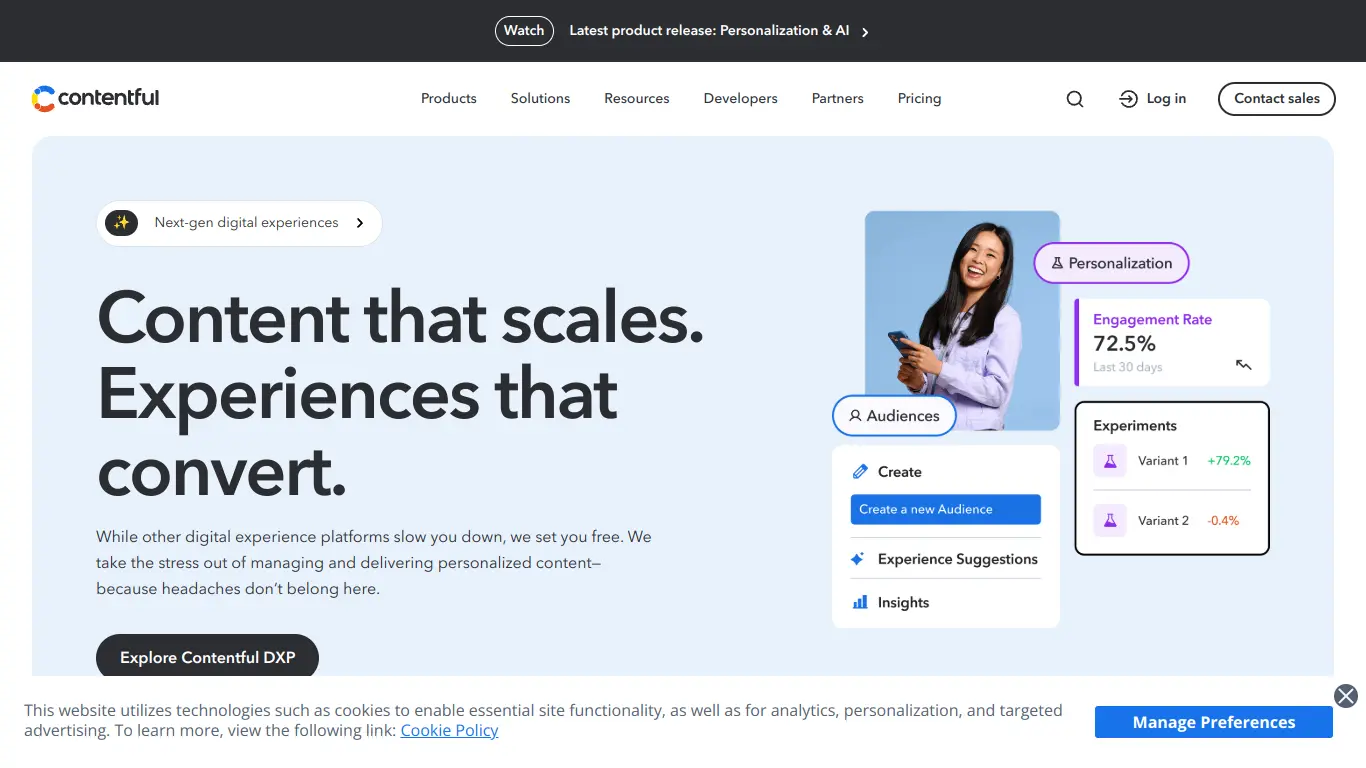
Are you struggling to manage digital content across multiple platforms? Do you find your team wasting time hunting for assets or rebuilding content for different channels? If you’re nodding along, you’re facing the same content chaos that plagues many modern businesses. The explosion of digital touchpoints has made traditional content management systems (CMS) increasingly ineffective, leaving teams frustrated and productivity stalled. This is exactly where Contentful steps in with a revolutionary approach to content management.
Introduction to Contentful
What is Contentful and its Purpose?
Contentful is not just another CMS – it’s a headless content management platform that separates content creation and storage from content presentation. This API-first approach delivers content to any digital channel, from websites and mobile apps to IoT devices and digital signage. Unlike traditional CMSs that tightly couple content with presentation, Contentful stores content as structured data that can be delivered anywhere through powerful APIs.
The platform’s core purpose is to solve the modern content crisis: enabling businesses to create, manage, and distribute content to any digital channel without rebuilding it for each platform. It effectively turns content into a reusable resource that flows freely wherever it’s needed.
As Contentful puts it, they’re building “the content platform that powers digital at scale,” helping organizations deliver exceptional digital experiences across all touchpoints.
Who is Contentful Designed For?
Contentful caters to a diverse range of users:
- Digital teams – From content creators and editors to developers and designers
- Enterprises – Organizations needing to manage complex content operations across multiple channels and markets
- Developers – Looking for flexible, API-driven content infrastructure
- Content creators – Who need intuitive tools without technical obstacles
- Marketing teams – Requiring agile content operations for multi-channel campaigns
- E-commerce businesses – Needing consistent product information across touchpoints
The platform particularly shines for organizations running omnichannel operations or those experiencing rapid digital growth. Companies like Spotify, Urban Outfitters, Shiseido, and Bang & Olufsen use Contentful to power their digital experiences.
Getting Started with Contentful: How to Use It
Getting started with Contentful is surprisingly straightforward for a platform with such powerful capabilities:
- Sign up for an account – Visit Contentful.com and create a free account
- Create your first space – A “space” is your content repository (you can have multiple spaces)
- Define content models – Create structured content types with customizable fields
- Add content – Use the intuitive interface to create and manage your content
- Connect your front-end – Use Contentful’s APIs to retrieve content for your websites, apps, or other channels
For beginners, Contentful offers excellent documentation, including quickstart guides for different programming languages and frameworks. Their “Getting Started” tutorials walk users through essential concepts like spaces, content models, entries, and assets.
A key advantage for non-technical users is the intuitive web app interface, which requires minimal training to use effectively. Meanwhile, developers appreciate the comprehensive API documentation and SDKs that streamline integration.
Contentful’s Key Features and Benefits
Core Functionalities of Contentful
Contentful’s feature set centers around making content truly adaptable and scalable:
- Content Modeling – Create custom content structures with a flexible field editor
- API-First Architecture – RESTful and GraphQL APIs for retrieving and managing content
- Content Hub – Centralized repository for all digital content
- Comprehensive Asset Management – Store, organize and deliver images, videos, and other files
- Localization Framework – Built-in tools for managing multilingual content
- Content Workflows – Customizable publishing workflows with roles and permissions
- Versioning and Rollback – Track changes and revert to previous versions when needed
- Content Preview – See how content will appear before publishing
- Rich Text Editor – Create formatted content with a user-friendly interface
- App Framework – Extend functionality with pre-built and custom integrations
The platform also offers built-in image optimization, robust search capabilities, webhooks for automating processes, and developer tools like SDKs for major programming languages.
Advantages of Using Contentful
Contentful delivers significant benefits that address many pain points in modern content management:
- Omnichannel Content Delivery – Create once, publish anywhere
- Improved Time-to-Market – Launch new digital experiences faster
- Enhanced Collaboration – Better workflow between technical and non-technical teams
- Future-Proof Architecture – Easily adapt to new channels and technologies
- Improved Performance – Deliver optimized content through CDNs
- Greater Flexibility – Model content exactly as needed for your business
- Reduced Development Time – Developers can focus on front-end experiences
- Seamless Integration – Works with your existing tech stack
- Enterprise-Grade Security – SOC 2 Type 2 compliance and robust permission controls
Many organizations report dramatic improvements after switching to Contentful. For example, TELUS Digital reduced development time by 40% after migrating from a traditional CMS.
Main Use Cases and Applications
Contentful’s versatility makes it suitable for numerous scenarios:
| Use Case | Description | Real-World Example |
|---|---|---|
| Multi-Channel Publishing | Manage content across websites, apps, kiosks, and more | Bang & Olufsen uses Contentful to deliver consistent product information across 100+ country sites |
| E-commerce | Manage product information and shopping experiences | Urban Outfitters uses Contentful to power their shopping experiences |
| Global Content Operations | Manage content across languages and regions | Nike uses Contentful to manage global marketing content |
| Agile Marketing | Quickly launch and iterate on campaigns | The British Museum uses Contentful for exhibition promotions |
| Digital Transformation | Modernize legacy content systems | TELUS used Contentful to replace 10+ CMSs |
| Personalized Experiences | Deliver targeted content to different user segments | Spotify uses Contentful to customize user experiences |
Exploring Contentful’s Platform and Interface
User Interface and User Experience
Contentful’s UI strikes an impressive balance between simplicity and power. The web app interface is organized into logical sections:
- Content section – Where editors create and manage entries and assets
- Media section – For managing digital assets like images and videos
- Settings section – For configuring content models, webhooks, and other technical aspects
The editing experience is particularly noteworthy. The interface uses a card-based layout that makes it easy to navigate between entries. The content editor itself uses a side-by-side view with fields on the left and a preview on the right – providing immediate visual feedback.
For content creators, the platform offers:
- An intuitive rich text editor
- Drag-and-drop media management
- Customizable entry editor
- Convenient reference fields for connecting related content
- Clear validation feedback
The UI also adapts based on user roles, showing relevant tools and hiding unnecessary complexity for different team members.
Platform Accessibility
Contentful demonstrates a strong commitment to accessibility in several ways:
- Web Standards Compliance – The interface follows WCAG guidelines
- Keyboard Navigation – Full functionality is available without a mouse
- Screen Reader Support – Compatible with assistive technologies
- Responsive Design – Works across different screen sizes
- API Access – Alternative ways to interact with content beyond the web interface
The platform is available in English, with solid international support for content in any language. The web app works in all modern browsers, and there’s a mobile app for iOS and Android that allows on-the-go content management.
For technical users, Contentful offers CLI tools and GraphQL playground for direct API interaction, providing flexibility in how teams interact with the platform.
Contentful Pricing and Plans
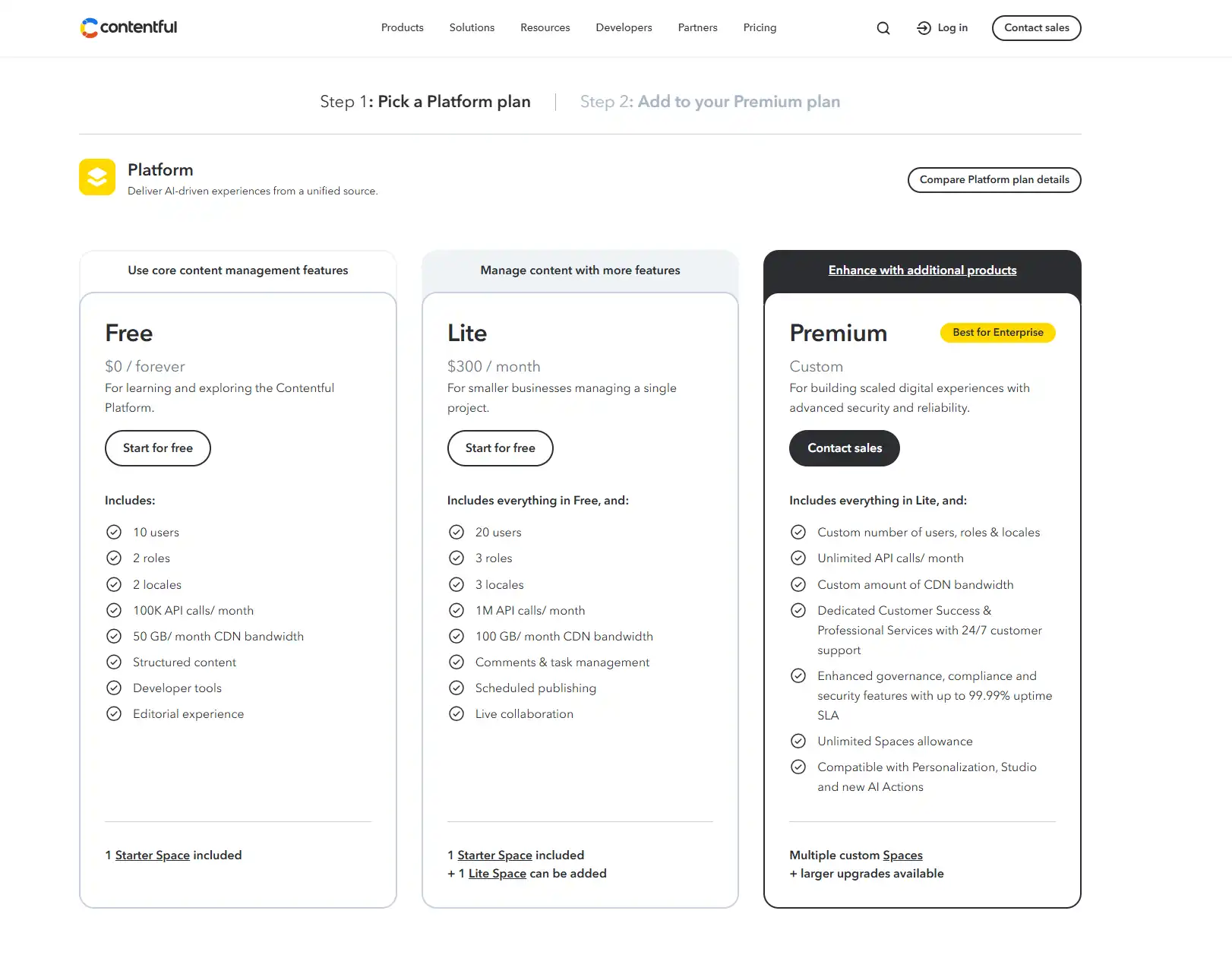
Contentful Reviews and User Feedback
Pros and Cons of Contentful
Based on aggregating user reviews from G2, Capterra, and TrustRadius, here’s how users evaluate Contentful:
Pros:
- ✅ Exceptional flexibility in content modeling
- ✅ Developer-friendly API approach
- ✅ Reliable performance and uptime
- ✅ Strong separation of content and presentation
- ✅ Excellent documentation
- ✅ Continuous platform improvements
- ✅ Robust image handling and optimization
- ✅ Strong user management and permissions
Cons:
- ❌ Steeper learning curve for non-technical users
- ❌ Pricing can be expensive for growing teams
- ❌ Limited built-in workflow capabilities in lower tiers
- ❌ Some users find the UI occasionally unintuitive
- ❌ Requires developer resources to set up initially
- ❌ Limited preview functionality compared to some competitors
The platform consistently scores highest for flexibility, reliability, and API quality, while the most common criticisms relate to pricing and initial setup complexity.
User Testimonials and Opinions
Real users share their experiences with Contentful:
“Contentful has completely transformed how our marketing team works with developers. We’re no longer dependent on engineering for content updates, and they’re free to focus on building great experiences rather than managing content.” – Marketing Director at a mid-size retail company
“As a developer, I appreciate the clean API approach. Contentful gives me the freedom to build front-ends with whatever technology makes sense, while the content team can work independently.” – Senior Developer at a technology company
“The pricing jumps significantly between tiers, which was challenging for our growing startup. That said, the productivity gains have largely justified the cost.” – CTO at a SaaS company
“There was definitely a learning curve for our content team coming from WordPress, but after the initial adjustment period, they’ve become more efficient and appreciate the structured approach.” – Digital Project Manager at a media company
The sentiment analysis of reviews shows overall satisfaction at approximately 4.3/5 stars across major review platforms, with highest marks coming from technical users and enterprises with complex content needs.
Contentful Company and Background Information
About the Company Behind Contentful
Contentful was founded in 2013 by Sascha Konietzke and Paolo Negri in Berlin, Germany. Their vision was to create a content infrastructure suited for the increasingly diverse digital landscape.
Key company milestones include:
- 2013: Founded in Berlin
- 2015: Secured Series A funding ($3.6M)
- 2016: Series B funding ($13M)
- 2018: Series C funding ($28M)
- 2019: Reached 270,000 community members
- 2020: Series D funding ($80M)
- 2021: Series E funding ($175M), valuing the company at over $3 billion
Today, Contentful has:
- 500+ employees
- Offices in Berlin, San Francisco, and Denver
- 30%+ of the Fortune 500 as customers
- A community of 2M+ developers
- Processing 6B+ API calls daily
The company has been recognized in Gartner’s Magic Quadrant for Digital Experience Platforms and has won numerous industry awards for innovation. Their leadership team brings experience from companies like Atlassian, Salesforce, and Adobe.
Contentful emphasizes a developer-first approach to content management and maintains an active open-source community through GitHub contributions and developer events.
Contentful Alternatives and Competitors
Top Contentful Alternatives in the Market
Several platforms compete with Contentful in the headless CMS and content platform space:
- Sanity.io (sanity.io) – A flexible headless CMS with a customizable editing environment
- Strapi (strapi.io) – Open-source headless CMS with strong self-hosting options
- Prismic (prismic.io) – User-friendly headless CMS with strong visual editing features
- Storyblok (storyblok.com) – Headless CMS with visual editor and strong multi-language support
- Directus (directus.io) – Open-source headless CMS and API builder
- Kentico Kontent (kontent.ai) – Enterprise headless CMS with strong workflow capabilities
Traditional CMS competitors offering headless capabilities include:
- WordPress with API capabilities
- Drupal with decoupled options
- Adobe Experience Manager
- Sitecore Content Hub
Contentful vs. Competitors: A Comparative Analysis
How does Contentful stack up against key competitors?
| Feature | Contentful | Sanity | Strapi | Prismic |
|---|---|---|---|---|
| Pricing | Free tier + paid plans starting $489/mo | Free tier + paid plans starting $99/mo | Free open-source + cloud from $9/mo | Free tier + paid plans from $9/mo |
| Hosting | Fully managed cloud | Fully managed cloud | Self-hosted or cloud | Fully managed cloud |
| Open Source | No | Partially | Yes | No |
| GraphQL | Yes | Yes | Yes | Limited |
| Content Modeling | Highly flexible | Highly flexible with code | Flexible | Moderate flexibility |
| UI Customization | Limited | Highly customizable | Moderate | Limited |
| Enterprise Features | Extensive | Growing | Limited | Moderate |
| Community Size | Very large | Growing | Large | Moderate |
Where Contentful Excels:
- Enterprise-grade reliability and scaling
- Robust permissions and governance
- Mature APIs and developer ecosystem
- Strong integration capabilities
Where Competitors May Have Advantages:
- Pricing (Strapi, Prismic)
- Open-source flexibility (Strapi)
- UI customization (Sanity)
- Visual editing experience (Storyblok, Prismic)
Your choice ultimately depends on your specific needs. Contentful generally leads for enterprise use cases, while alternatives may offer better value for smaller projects or specific requirements like self-hosting.
Contentful Website Traffic and Analytics
Website Visit Over Time
Contentful.com has shown consistent growth in web traffic over recent years, reflecting the increasing interest in headless CMS solutions. According to SimilarWeb and Ahrefs data:
- Monthly visits: Approximately 1.2-1.5 million
- Year-over-year growth: ~18-20%
- Average time on site: 4:32 minutes
- Pages per visit: 3.4
Traffic spikes typically coincide with major product announcements, conference events like their annual “Fast Forward” conference, and industry events focused on headless CMS technologies.
Geographical Distribution of Users
Contentful’s user base is global, but with distinct concentrations:
- United States (28%)
- Germany (11%)
- United Kingdom (9%)
- Canada (5%)
- India (4%)
- France (3%)
- Other countries (40%)
This distribution aligns with tech-forward markets where digital experience platforms see highest adoption. Europe and North America represent the strongest regional bases for the company.
Main Traffic Sources
How are users finding Contentful?
- Organic search: 52% (primary keywords include “headless cms,” “contentful cms,” “content infrastructure”)
- Direct traffic: 28%
- Referrals: 11% (primarily from GitHub, Stack Overflow, and tech publications)
- Social media: 5% (LinkedIn and Twitter dominate)
- Paid search: 4%
The high proportion of organic traffic indicates strong SEO performance and brand recognition in the CMS space. The significant direct traffic suggests strong brand awareness among developers and content professionals.
Frequently Asked Questions about Contentful (FAQs)
General Questions about Contentful
What makes Contentful different from traditional CMS platforms?
Contentful separates content creation from presentation, using APIs to deliver content to any channel. Traditional CMSs typically combine content and presentation in a single system, making multi-channel publishing difficult.
Is Contentful suitable for small businesses?
Yes, with some considerations. The free tier works well for small projects, though smaller businesses should be aware of the significant jump in pricing to paid tiers. Small teams with some technical capability can benefit greatly from Contentful’s flexibility.
How long does it take to implement Contentful?
Basic implementation can be accomplished in days, but a full enterprise implementation typically takes 2-12 weeks, depending on complexity, migration needs, and integration requirements.
Feature Specific Questions
Can Contentful handle e-commerce product information?
Yes, Contentful works well for product information management and can integrate with e-commerce platforms like Shopify, Commercetools, and custom solutions. Many retailers use Contentful to manage rich product content while using specialized systems for inventory and transactions.
Does Contentful support multi-language content?
Absolutely. Contentful has robust localization features built-in, allowing you to manage content in any language. You can define which fields need translation and which should remain consistent across all languages.
Can Contentful replace my existing CMS?
Yes, but migration requires planning. Contentful provides migration tools and services to help transfer content from legacy systems. Many organizations adopt a phased approach, running Contentful alongside existing systems during transition.
Pricing and Subscription FAQs
What happens if I exceed my plan limits?
Contentful monitors usage and will notify you when approaching limits. If you consistently exceed limits, they typically contact you to discuss upgrading your plan rather than implementing hard cutoffs.
Is there a discount for annual billing?
Yes, Contentful offers approximately 10-15% discount for annual commitments versus monthly billing on their paid plans.
Can I change plans as my needs grow?
Yes, you can upgrade at any time. Downgrading is possible but may require adjustments if you’re using features only available in higher tiers.
Support and Help FAQs
What support options are available?
- Free tier: Community forums and documentation
- Basic tier: Email support with 24-hour response time
- Premium tier: Priority support with faster response times
- Enterprise tier: Dedicated support team with phone support and custom SLAs
Is there training available for new users?
Contentful offers extensive documentation, tutorial videos, and webinars. For enterprise customers, they provide customized training sessions. There’s also a certification program for developers and content managers.
Can Contentful help with implementation?
Contentful offers professional services for implementation and has a network of certified solution partners who can assist with setup, migration, and custom development.
Conclusion: Is Contentful Worth It?
Summary of Contentful’s Strengths and Weaknesses
After thoroughly examining Contentful, here’s how its key strengths and weaknesses balance out:
Strengths:
- 🌟 Truly flexible content model that adapts to your needs
- 🌟 API-first approach that future-proofs your content
- 🌟 Excellent for multi-channel and omnichannel strategies
- 🌟 Strong developer experience with comprehensive documentation
- 🌟 Enterprise-grade security and governance
- 🌟 Reliable performance at scale
- 🌟 Continuous platform improvements and innovation
Weaknesses:
- ⚠️ Significant price jump from free to paid tiers
- ⚠️ Steeper learning curve for non-technical users
- ⚠️ Requires developer resources for initial setup
- ⚠️ Native workflow capabilities could be stronger
- ⚠️ Some enterprises may find limitations in content preview features
Final Recommendation and Verdict
Contentful delivers on its promise of providing a flexible, scalable content platform that powers digital experiences across channels. It represents the future of content management – separating content from presentation and enabling true omnichannel delivery.
Contentful is ideal for:
- Medium to large organizations with multi-channel content needs
- Teams with technical resources or development partners
- Businesses undergoing digital transformation
- Organizations with complex, structured content requirements
- Companies looking to future-proof their content architecture
Contentful may not be the best fit for:
- Small businesses with very limited budgets
- Organizations with minimal technical resources
- Simple websites with basic content needs
- Teams requiring extensive visual page building
The verdict? Contentful earns 4.5/5 stars as a content platform. Its strengths dramatically outweigh its weaknesses for most use cases, particularly for organizations serious about digital transformation and omnichannel content delivery. The initial investment in time and resources pays significant dividends in flexibility, scalability, and future-readiness.
If you’re ready to take your content management to the next level, Contentful merits serious consideration. Start with the free tier to explore its capabilities and determine if it’s the right fit for your organization’s content challenges.