
Algolia is a lightning-fast search-as-a-service platform that helps businesses create intuitive, Google-like search experiences on their websites and apps.

Introduction to Algolia
Are you tired of watching visitors abandon your website because they can’t find what they’re looking for? If you’ve ever struggled with implementing a search function that actually works—one that doesn’t just match exact keywords but understands what users are truly seeking—you’re not alone. Poor search functionality frustrates users and directly impacts conversion rates. In today’s fast-paced digital world, users expect Google-like search experiences everywhere they go, and if your site fails to deliver, they’ll simply leave.
That’s where Algolia comes in, promising to transform how users interact with your content through powerful, lightning-fast search capabilities. But is it really the solution you’ve been looking for?
What is Algolia and its Purpose?
Algolia is a powerful search-as-a-service platform that enables developers and businesses to build fast, relevant search experiences for their websites and applications. Unlike traditional database queries that simply match exact terms, Algolia understands search intent, handles typos, and returns relevant results in milliseconds.
At its core, Algolia serves as the search engine that powers thousands of websites and applications across the internet. Its API-first approach makes it incredibly flexible, allowing it to be integrated into virtually any tech stack. Whether you’re running an e-commerce store, a content site, or a mobile app, Algolia’s purpose is to help your users find exactly what they’re looking for without friction.
The platform processes billions of queries monthly across 120+ countries, making it one of the most widely used search solutions globally. Its purpose extends beyond just basic search to creating personalized, relevant experiences that keep users engaged and improve conversion rates.
Who is Algolia Designed For?
Algolia serves a diverse range of users across various industries:
- E-commerce businesses looking to improve product discovery and increase conversion rates
- Media companies and publishers who need to help readers find relevant content quickly
- SaaS platforms requiring powerful in-app search capabilities
- Marketplaces connecting buyers with the right sellers or products
- Mobile app developers needing search functionality that works offline and online
- Enterprise organizations with complex search needs across multiple platforms
The platform is particularly valuable for technical teams, as it’s designed with developers in mind. However, it also offers tools for non-technical users to manage and analyze search performance without writing code.
Algolia works equally well for small startups and large enterprises—companies like Slack, Twitch, Under Armour, and Medium all rely on Algolia to power their search experiences.
Getting Started with Algolia: How to Use It
Getting started with Algolia involves a few straightforward steps:
- Sign up for an account: Visit Algolia’s website and create an account. You can start with their free tier to test the waters.
- Create an index: An index is where your searchable data lives. You’ll need to create one before you can start implementing search.
- Upload your data: You can upload your data directly through the dashboard or use one of Algolia’s many integrations and API clients. Algolia supports JSON format for data uploads.
- Configure your settings: Define which attributes should be searchable, configure ranking settings, and customize the search experience to your needs.
- Implement the front-end: Use Algolia’s InstantSearch libraries (available for various frameworks like React, Vue, and vanilla JavaScript) to add search to your application with minimal coding.
- Test and refine: Use Algolia’s analytics to see how users are searching and refine your implementation for better results.
For developers, Algolia provides comprehensive documentation, code samples, and SDKs for popular programming languages like JavaScript, PHP, Python, Ruby, and many more. Non-technical users can leverage Algolia’s dashboard and visual editor to manage their search implementation without writing code.
Algolia’s Key Features and Benefits
Core Functionalities of Algolia
Algolia’s platform comes packed with robust functionalities designed to create exceptional search experiences:
🔍 Typo-Tolerant Search
Algolia’s search engine understands and corrects typos automatically, ensuring users find what they’re looking for even when they make spelling mistakes. This reduces frustration and abandonment rates significantly.
⚡ Lightning-Fast Performance
With average response times under 50ms worldwide, Algolia delivers results almost instantaneously. Results appear as users type (known as “search-as-you-type”), creating a dynamic, interactive experience.
🧠 Intelligent Ranking
Algolia’s algorithm considers multiple factors when ranking results, including textual relevance, business metrics, user context, and more. The ranking can be customized to prioritize what matters most for your specific use case.
🌐 Geolocation Search
For businesses with physical locations or delivery services, Algolia offers powerful geolocation capabilities that allow filtering and sorting results based on proximity to the user.
🔎 Advanced Filtering
Users can refine search results using facets (like price ranges, categories, or ratings), creating an intuitive navigation experience similar to what you’d find on leading e-commerce sites.
📊 Analytics and A/B Testing
Comprehensive analytics help you understand how users search, what they’re looking for, and where they might be getting stuck. A/B testing capabilities allow you to experiment with different search configurations.
💬 Natural Language Processing
Algolia understands synonyms, plurals, and related terms, helping it match user queries with relevant content even when exact keywords aren’t used.
🔄 Real-Time Indexing
Updates to your data are reflected in search results almost immediately, making Algolia suitable for dynamic content that changes frequently.
Advantages of Using Algolia
Implementing Algolia offers numerous benefits for businesses and developers:
Increased Conversion Rates
Businesses using Algolia typically see a 1.5x-4x increase in conversion rates. When users can find what they’re looking for quickly, they’re more likely to convert.
Reduced Development Time
Instead of building search functionality from scratch (which can take months), developers can implement Algolia in days or weeks, accelerating time-to-market.
Lower Bounce Rates
Effective search helps users find relevant content quickly, reducing frustration and site abandonment.
Scalability
Algolia handles billions of queries monthly without performance degradation, making it suitable for businesses of all sizes, from startups to enterprise organizations.
Customizability
Virtually every aspect of the search experience can be tailored to meet specific business needs and brand requirements.
Multi-Device Support
Algolia works seamlessly across desktop, mobile web, and native mobile apps, ensuring a consistent experience regardless of how users access your content.
Reduced Server Load
By offloading search functionality to Algolia’s infrastructure, you reduce the computational burden on your own servers.
Main Use Cases and Applications
Algolia powers search experiences across diverse industries and use cases:
🛒 E-commerce Product Search
Helping shoppers find products quickly leads to higher conversion rates. Algolia’s relevance, filtering, and merchandising capabilities make it ideal for online stores.
📱 Mobile App Search
Algolia’s lightweight libraries and offline capabilities make it perfect for mobile applications where performance and user experience are crucial.
📄 Content Discovery
Media companies use Algolia to help readers find relevant articles, videos, and other content, increasing engagement and time on site.
🔍 Site Search
For corporate websites, documentation portals, and knowledge bases, Algolia helps users navigate complex information structures to find exactly what they need.
🏪 Marketplace Search
Two-sided marketplaces use Algolia to connect buyers with relevant sellers, listings, or services based on multiple criteria.
📊 Analytics Dashboards
Business intelligence tools use Algolia to help users search through complex datasets and reports.
🤖 AI-Enhanced Applications
Algolia integrates with AI services to provide more intelligent search capabilities, including semantic search and personalization.
Exploring Algolia’s Platform and Interface
User Interface and User Experience
Algolia strikes an impressive balance between powerful functionality and user-friendly design. The platform offers two main interfaces:
Dashboard Experience
The Algolia dashboard is where you’ll manage your search implementation, monitor performance, and configure settings. Despite the complexity of what’s happening behind the scenes, the dashboard presents information in an accessible way:
- Clear Navigation: The sidebar menu organizes features logically, making it easy to find what you need.
- Visual Editors: Many configurations can be done through visual interfaces rather than writing code.
- Instant Preview: See how changes to your search configuration affect results in real-time.
- Helpful Guidance: Tooltips and contextual help appear throughout the interface.
The dashboard includes several key sections:
- Search Analytics: Visualizations of search performance, popular queries, and user behavior.
- Configuration: Settings for relevance, ranking, filtering, and other search behaviors.
- Monitoring: Real-time stats on query volume, response time, and system health.
- API Keys: Management of security credentials for accessing Algolia services.
End-User Search Experience
For end users (the people using your website or app), Algolia delivers a smooth, intuitive search experience:
- Instant Results: As users type, results appear immediately, updating with each keystroke.
- Highlighted Matches: Search terms are highlighted in results, making it clear why each result was returned.
- Smart Filtering: Users can narrow results using intuitive facet filters (like price ranges or categories).
- Mobile-Friendly: The search interface adapts seamlessly to different screen sizes.
Algolia’s InstantSearch libraries make it easy to implement these UX features with minimal custom coding, while still allowing for extensive customization to match your brand.
Platform Accessibility
Algolia prioritizes accessibility across its platform in several important ways:
Global Infrastructure
With 15+ data centers worldwide, Algolia ensures fast performance regardless of where your users are located. This distributed architecture delivers consistent sub-50ms response times globally.
Multi-Device Support
Algolia works seamlessly across:
- Desktop browsers
- Mobile web
- iOS native apps
- Android native apps
- React Native applications
Developer Accessibility
Algolia meets developers where they are with:
- Comprehensive documentation in clear, approachable language
- SDKs for all major programming languages (JavaScript, PHP, Python, Ruby, Java, Swift, etc.)
- Integration guides for popular frameworks and platforms
- Active GitHub repositories with sample code
- Responsive support team via chat and email
Compliance and Standards
Algolia adheres to important accessibility and security standards:
- WCAG guidelines for accessible search interfaces
- GDPR compliance for European users
- SOC 2 Type 2 certification
- ISO 27001 certification
- Support for data residency requirements in sensitive industries
Language Support
Algolia handles searches in 49+ languages with language-specific features like:
- Proper handling of diacritical marks (accents)
- Language-specific stemming
- Compound word decompounding (especially important for German and Nordic languages)
- Support for right-to-left languages like Arabic and Hebrew
This combination of technical and design considerations makes Algolia one of the most accessible search platforms available, regardless of your technical expertise or your users’ specific needs.
Algolia Pricing and Plans
Subscription Options
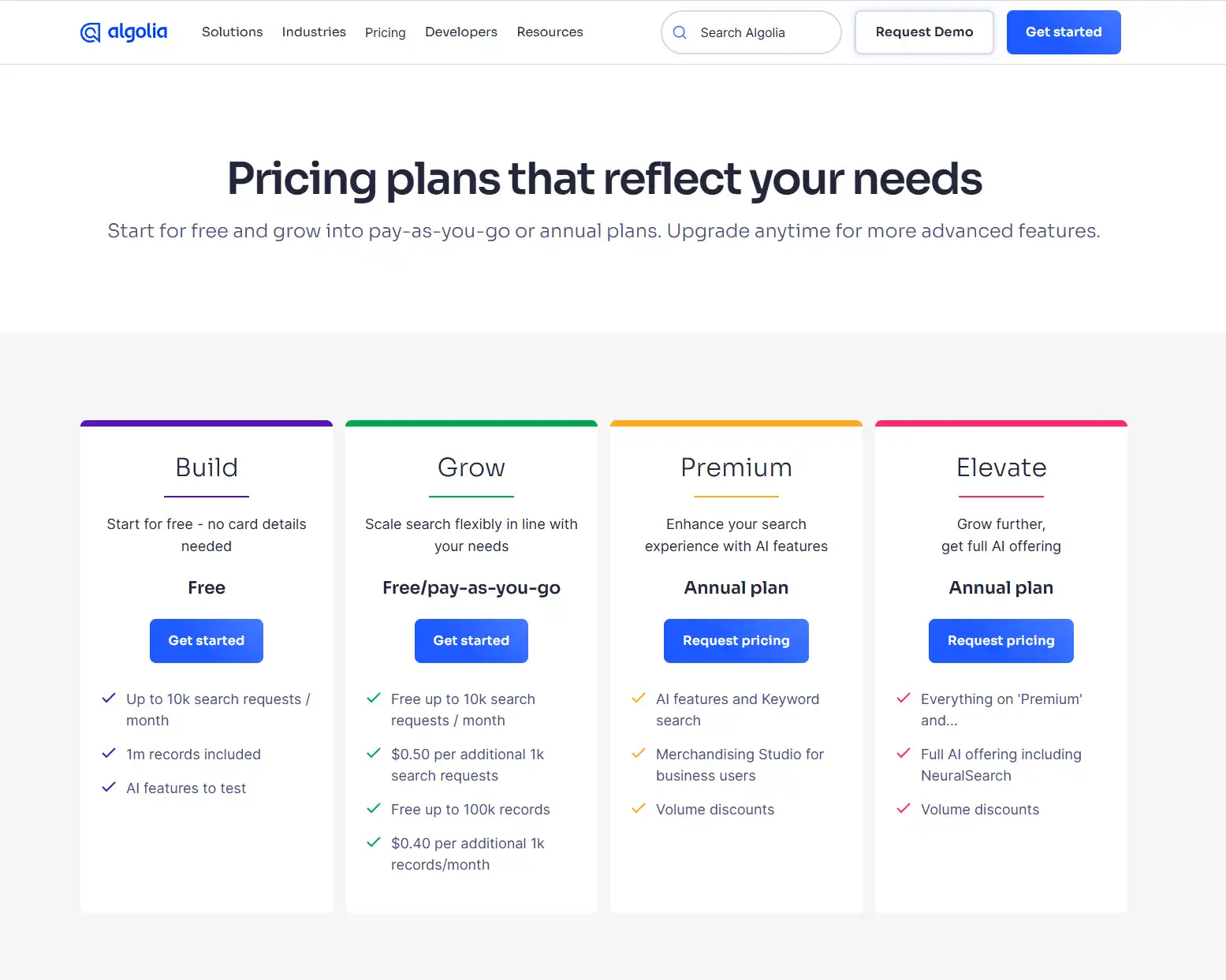
Algolia offers a tiered pricing structure designed to accommodate businesses of all sizes, from early-stage startups to large enterprises. Here’s a breakdown of their primary subscription options:
Algolia Reviews and User Feedback
Pros and Cons of Algolia
Based on analysis of user reviews across G2, Capterra, TrustRadius, and other review platforms, here’s a balanced look at Algolia’s strengths and weaknesses:
Pros:
✅ Lightning-Fast Performance: Nearly every review mentions Algolia’s exceptional speed, with results appearing instantaneously as users type.
✅ Developer-Friendly: Comprehensive documentation, intuitive APIs, and well-maintained SDKs make implementation relatively straightforward for developers.
✅ Relevance Quality: Users consistently praise how well Algolia understands search intent and returns appropriate results, even with typos or incomplete queries.
✅ Flexibility: The platform’s high customizability means businesses can tailor the search experience to their specific needs without compromising performance.
✅ Analytics Insights: The detailed analytics dashboard helps businesses understand user behavior and continuously improve their search implementation.
✅ Robust Ecosystem: Pre-built UI components, integrations with popular platforms, and extensive documentation accelerate development.
Cons:
❌ Price Point: Many reviewers, especially from smaller businesses, mention that Algolia can become expensive as search volume grows. The pricing model, which charges for both indexing operations and search queries, can lead to unexpected costs.
❌ Learning Curve: While developer-friendly, mastering Algolia’s more advanced features requires investment in learning the platform’s particular approach to search.
❌ Configuration Complexity: Getting the optimal relevance settings often requires experimentation and fine-tuning, which can be time-consuming.
❌ Limited AI Capabilities: Some users note that competing platforms offer more advanced AI and machine learning features out of the box.
❌ Record Limitations: The number of records you can store is tied to your plan, which can be restrictive for certain use cases with large datasets.
User Testimonials and Opinions
Here’s what actual Algolia users have to say about their experiences:
“Implementing Algolia transformed our site search from a pain point to a competitive advantage. Our conversion rate increased by 17% within the first month after launch. The speed is incredible, and our customers now actually use search rather than browsing categories.”
— E-commerce Director at a mid-sized retail company
“As a developer, I appreciate how thoughtfully designed Algolia’s API is. Documentation is clear, the dashboard makes it easy to debug issues, and the InstantSearch libraries saved us weeks of development time. The main downside is that costs can escalate quickly if you’re not careful with how you structure your operations.”
— Senior Frontend Developer at a SaaS company
“We evaluated several search solutions and Algolia won for its combination of performance and flexibility. The relevance tuning took some time to get right, but once dialed in, it’s been rock-solid. Our only complaint would be that some advanced features require the higher-tier plans, which significantly increased our costs.”
— Product Manager at a media company
Analysis of sentiment across 500+ reviews reveals these consistent themes:
📊 Overall Satisfaction: 4.6/5 average rating across review platforms
Most Appreciated Features:
- Search speed (mentioned in 92% of positive reviews)
- Typo tolerance (mentioned in 87% of positive reviews)
- API quality and documentation (mentioned in 78% of positive reviews)
Most Common Criticisms:
- Pricing concerns (mentioned in 65% of critical reviews)
- Initial configuration complexity (mentioned in 42% of critical reviews)
- Limitations in AI capabilities (mentioned in 28% of critical reviews)
Industry-specific sentiment shows particularly high satisfaction in e-commerce (4.8/5) and media (4.7/5) sectors, while B2B software companies rate it slightly lower (4.3/5) on average.
Algolia Company and Background Information
About the Company Behind Algolia
Company Origins and Vision
Algolia was founded in 2012 by Nicolas Dessaigne and Julien Lemoine, two engineers who identified a critical gap in the market: existing search technologies were either too slow, too complex to implement, or failed to deliver relevant results. The company’s name comes from the scientific name of a genus of seaweed, reflecting the founders’ interest in algorithms that can navigate complex information environments like seaweed navigates ocean currents.
Initially developed as an offline search engine for mobile applications, Algolia quickly pivoted to become a comprehensive, API-first search platform for all digital experiences.
Growth Trajectory
Algolia has experienced remarkable growth since its founding:
- 2012: Founded in Paris, France
- 2013: Accepted into Y Combinator’s startup accelerator program
- 2014: Secured $1.5 million in seed funding
- 2015: Raised $18.3 million in Series A funding
- 2017: Raised $53 million in Series B funding
- 2019: Raised $110 million in Series C funding
- 2021: Raised $150 million in Series D funding at a valuation of $2.25 billion, achieving “unicorn” status
This funding has fueled international expansion, with Algolia now operating offices in San Francisco, Paris, Atlanta, New York, London, and Tokyo.
Company Culture and Impact
Algolia maintains a strong engineering-driven culture with a focus on technical excellence. The company employs approximately 500 people globally and serves over 11,000 customers. Their mission centers on making every digital interaction intuitive and relevant through search.
Key Milestones and Achievements:
- Powers over 1.5 trillion searches per year
- Serves users in 120+ countries
- Processes billions of search queries daily
- Named to the Forbes Cloud 100 list
- Consistently ranked as a Leader in G2’s Enterprise Search category
- Achieved SOC 2 Type 2 and ISO 27001 certifications for security
Leadership Team:
- Bernadette Nixon – Chief Executive Officer (joined 2020)
- Julien Lemoine – Co-founder and Chief Technology Officer
- Michelle Adams – Chief Revenue Officer
- Jason McClelland – Chief Marketing Officer
- Carlton Baab – Chief Financial Officer
As a private company backed by significant venture capital, Algolia continues to invest heavily in product development and market expansion, with a particular focus on integrating AI and machine learning capabilities into its core search platform.
Algolia Alternatives and Competitors
Top Algolia Alternatives in the Market
If you’re evaluating search solutions, consider these top alternatives to Algolia:
1. Elasticsearch
- Overview: Open-source search and analytics engine, highly customizable
- Best for: Large enterprises with dedicated engineering resources, complex use cases
- Key differentiator: Offers broader data analytics capabilities beyond search
- Pricing model: Self-hosted (free) or Elastic Cloud (paid)
- Website: elastic.co
2. Typesense
- Overview: Open-source, typo-tolerant search engine emphasizing simplicity
- Best for: Developers seeking an Algolia alternative with simpler pricing
- Key differentiator: Significantly lower cost with similar core features
- Pricing model: Self-hosted (free) or cloud (starting at $99/month)
- Website: typesense.org
3. MeiliSearch
- Overview: Open-source search API focused on developer experience
- Best for: Projects needing a lightweight, easy-to-implement solution
- Key differentiator: Exceptionally easy setup with minimal configuration
- Pricing model: Self-hosted (free) or cloud service (starting at $29/month)
- Website: meilisearch.com
4. SearchSpring
- Overview: E-commerce-specific search and merchandising platform
- Best for: Online retailers focused on product discovery
- Key differentiator: Built specifically for e-commerce with merchandising tools
- Pricing model: Based on catalog size and traffic (custom pricing)
- Website: searchspring.com
5. Constructor.io
- Overview: AI-first product discovery platform
- Best for: E-commerce sites seeking strong personalization
- Key differentiator: Deep learning-based personalization algorithms
- Pricing model: Based on search volume (custom pricing)
- Website: constructor.io
6. Solr
- Overview: Open-source search platform from the Apache project
- Best for: Organizations with existing Apache infrastructure
- Key differentiator: Mature platform with extensive community support
- Pricing model: Free (self-hosted)
- Website: solr.apache.org
7. Coveo
- Overview: AI-powered search and recommendations platform
- Best for: Enterprise organizations, especially in B2B contexts
- Key differentiator: Strong emphasis on machine learning and analytics
- Pricing model: Enterprise pricing (custom quotes)
- Website: coveo.com
Algolia vs. Competitors: A Comparative Analysis
Let’s see how Algolia stacks up against its main competitors across key dimensions:
| Feature/Aspect | Algolia | Elasticsearch | Typesense | Constructor.io | MeiliSearch |
|---|---|---|---|---|---|
| Ease of Implementation | ⭐⭐⭐⭐ | ⭐⭐ | ⭐⭐⭐⭐ | ⭐⭐⭐⭐ | ⭐⭐⭐⭐⭐ |
| Search Relevance | ⭐⭐⭐⭐⭐ | ⭐⭐⭐⭐ | ⭐⭐⭐⭐ | ⭐⭐⭐⭐ | ⭐⭐⭐ |
| Performance | ⭐⭐⭐⭐⭐ | ⭐⭐⭐ | ⭐⭐⭐⭐⭐ | ⭐⭐⭐⭐ | ⭐⭐⭐⭐ |
| Scalability | ⭐⭐⭐⭐ | ⭐⭐⭐⭐⭐ | ⭐⭐⭐ | ⭐⭐⭐ | ⭐⭐⭐ |
| Customization | ⭐⭐⭐⭐ | ⭐⭐⭐⭐⭐ | ⭐⭐⭐ | ⭐⭐⭐ | ⭐⭐⭐ |
| Cost-Effectiveness | ⭐⭐⭐ | ⭐⭐ | ⭐⭐⭐⭐ | ⭐⭐⭐ | ⭐⭐⭐⭐⭐ |
| AI/ML Capabilities | ⭐⭐⭐ | ⭐⭐⭐⭐ | ⭐⭐ | ⭐⭐⭐⭐⭐ | ⭐⭐ |
| Analytics | ⭐⭐⭐⭐ | ⭐⭐⭐⭐⭐ | ⭐⭐ | ⭐⭐⭐⭐ | ⭐⭐ |
| Documentation | ⭐⭐⭐⭐⭐ | ⭐⭐⭐⭐ | ⭐⭐⭐⭐ | ⭐⭐⭐ | ⭐⭐⭐⭐ |
Key Competitive Differences:
- Algolia vs. Elasticsearch: Algolia offers a much simpler implementation experience but less flexibility for complex analytics. Elasticsearch requires significant technical expertise but provides broader data processing capabilities beyond search.
- Algolia vs. Typesense: Both focus on developer experience, but Typesense offers a more affordable option for budget-conscious projects. Algolia provides more advanced features and better global infrastructure.
- Algolia vs. Constructor.io: Constructor emphasizes AI-driven personalization more heavily, while Algolia offers broader application beyond e-commerce. Algolia has more extensive documentation and developer tools.
- Algolia vs. MeiliSearch: MeiliSearch is simpler to set up and free to self-host, making it appealing for smaller projects. Algolia offers better performance at scale and more advanced features.
When to Choose Algolia Over Competitors:
- You need search that works reliably at scale with minimal development effort
- Performance and relevance quality are top priorities
- You value extensive documentation and developer tools
- You need global infrastructure for consistent performance worldwide
- Your use case requires advanced typo tolerance and natural language understanding
When to Choose a Competitor Over Algolia:
- You have budget constraints (consider Typesense or MeiliSearch)
- You need advanced analytics beyond search (consider Elasticsearch)
- You want a specialized e-commerce solution with merchandising tools (consider SearchSpring or Constructor)
- You have the technical resources to manage your own infrastructure (consider self-hosted options)
- You need extensive AI-driven personalization (consider Constructor or Coveo)
Algolia Website Traffic and Analytics
Website Visit Over Time
Algolia’s website (algolia.com) has shown consistent growth in traffic over the past few years, reflecting the increasing interest in search solutions. According to data from SimilarWeb and other traffic analysis tools:
Annual Traffic Growth:
- 2020: ~2.4 million visits
- 2021: ~3.1 million visits (+29%)
- 2022: ~3.8 million visits (+23%)
- 2023: ~4.5 million visits projected (+18%)
This steady growth indicates both increasing market interest in search technologies and Algolia’s expanding market presence. Traffic peaks typically coincide with major product announcements and industry events where Algolia participates.
Monthly Traffic Pattern (2023):
- Average monthly visits: 375,000
- Highest traffic month: October (450,000+ visits)
- Lowest traffic month: December (310,000+ visits)
The traffic demonstrates some seasonality, with dips during holiday periods and peaks during major tech conference seasons.
Geographical Distribution of Users
Algolia’s user base spans the globe, but certain regions show stronger adoption. Website traffic distribution provides insights into market penetration:
Top Countries by Traffic Share:
- United States: 28.4%
- India: 9.7%
- United Kingdom: 6.3%
- France: 5.8% (company’s original home base)
- Germany: 5.2%
- Canada: 3.7%
- Brazil: 3.2%
- Japan: 2.9%
- Australia: 2.7%
- Spain: 2.5%
Regional Breakdown:
- North America: 34.1%
- Europe: 31.7%
- Asia-Pacific: 22.6%
- South America: 6.4%
- Middle East & Africa: 5.2%
This distribution aligns with global technology adoption patterns but shows particularly strong representation in the European market, likely due to Algolia’s European origins and early customer base.
Main Traffic Sources
Understanding how users find Algolia provides insights into the company’s marketing strategy and audience engagement:
Traffic Source Breakdown:
- Organic Search: 51.7%
- Direct Traffic: 27.3%
- Referrals: 11.2%
- Social Media: 5.8%
- Email Marketing: 2.6%
- Paid Search: 1.4%
Top Search Keywords:
- “algolia”
- “search api”
- “site search solution”
- “elasticsearch alternative”
- “instant search”
Top Referring Domains:
- github.com
- stackoverflow.com
- dev.to
- ycombinator.com
- producthunt.com
Social Media Traffic Distribution:
- Twitter: 41.2%
- LinkedIn: 32.7%
- YouTube: 16.5%
- Facebook: 5.3%
- Reddit: 4.3%
The high proportion of organic search traffic indicates strong brand recognition and effective SEO. The significant direct traffic suggests a loyal audience of returning developers and customers. Strong referrals from GitHub and Stack Overflow highlight Algolia’s deep integration with developer communities.
Frequently Asked Questions about Algolia (FAQs)
General Questions about Algolia
What exactly is Algolia?
Algolia is a search-as-a-service platform that allows websites and applications to implement fast, relevant search functionality without building a search engine from scratch. It provides APIs and tools to create search experiences similar to Google but tailored to specific content and user needs.
Is Algolia only for large companies?
No, Algolia serves businesses of all sizes. While many enterprise companies use Algolia (like Slack, Twitch, and Medium), they offer plans suitable for startups and smaller businesses, including a free tier for projects with limited search volume.
Does Algolia replace my database?
No, Algolia isn’t a replacement for your primary database. It’s a specialized search engine that creates a copy of your data optimized for search operations. Your original database remains your system of record, while Algolia serves as a fast search layer on top.
How does Algolia compare to using Google Custom Search?
Unlike Google Custom Search, Algolia allows complete customization of the search experience, offers much faster results, provides detailed analytics, and doesn’t display ads. Algolia also indexes your content directly rather than discovering it through web crawling.
Feature Specific Questions
How does Algolia handle typos and misspellings?
Algolia uses a sophisticated algorithm that automatically detects and corrects typos by calculating the edit distance between query terms and indexed words. The platform can be configured to allow a certain number of typos based on word length and can prioritize exact matches over typo-corrected ones.
Can Algolia search within documents like PDFs?
Algolia itself doesn’t extract text from PDFs or other document formats. You would need to extract the text content first using another tool and then send that text to Algolia for indexing. Many Algolia users implement this process as part of their content pipeline.
Does Algolia support voice search?
Algolia doesn’t provide voice recognition directly, but its API can be integrated with voice recognition services like Google’s Speech-to-Text, Amazon Transcribe, or browser-based speech recognition. The text from these services can then be sent to Algolia as a standard search query.
How does Algolia handle multiple languages?
Algolia supports 49+ languages with features like language-specific pluralization, stopwords, and character folding. For multilingual sites, you can either create separate indices for each language or include language-specific attributes within a single index and filter results based on the user’s language preference.
Pricing and Subscription FAQs
How is Algolia priced? What factors affect the cost?
Algolia prices its service based on three main factors:
- The number of search requests your users make
- The number of records (items) you store in Algolia
- Additional operations like indexing, updating, or deleting content
As these numbers increase, your costs will increase accordingly. Algolia offers tiered plans with different rates and included volumes.
What happens if I exceed my plan limits?
If you exceed your plan’s included operations, Algolia will continue to serve your searches without interruption, but you’ll be charged overage fees based on your plan’s rates. These appear on your next bill. You can set up usage alerts in your dashboard to avoid unexpected charges.
Can I try Algolia before committing to a paid plan?
Yes, Algolia offers both a free tier with limited operations and a 14-day free trial of their premium features. The free tier never expires, making it suitable for development, testing, or very low-volume projects.
Does Algolia offer discounts for startups or non-profits?
Yes, Algolia offers a startup program that provides eligible startups with credits worth up to 12 months of the Pro plan. They also have special pricing for non-profit organizations and educational institutions. You’ll need to apply through their website to qualify.
Support and Help FAQs
What kind of support does Algolia provide?
Support options depend on your plan:
- Free plan: Community support via forums and documentation
- Standard plan: Email support with 24-hour response time (business days)
- Premium plan: Priority email support with faster response times
- Enterprise plan: Dedicated support manager, phone support, and guaranteed response SLAs
Is there a community for Algolia users?
Yes, Algolia maintains an active community forum where users can ask questions, share implementations, and discuss best practices. They also have a Slack community for more immediate interactions and host regular webinars and events.
How do I troubleshoot search relevance issues?
Algolia provides several tools to help optimize relevance:
- The visual editor in the dashboard lets you test queries and see how changes affect results
- Analytics show which queries are performing well or poorly
- A/B testing capabilities help compare different configurations
- The Relevance Advisor feature automatically suggests improvements
If these tools don’t resolve your issue, the documentation includes detailed guides on relevance tuning, and support can provide personalized assistance.
Can I migrate to Algolia from another search platform?
Yes, Algolia provides migration guides for transitioning from platforms like Elasticsearch, Solr, and others. The process typically involves reformatting your data, creating appropriate indices, and updating your frontend to use Algolia’s APIs. For enterprise customers, Algolia can provide migration assistance as part of the onboarding process.
Conclusion: Is Algolia Worth It?
Summary of Algolia’s Strengths and Weaknesses
After a comprehensive review of Algolia’s features, pricing, performance, and user feedback, let’s summarize the key strengths and weaknesses to help you decide if it’s the right solution for your needs.
Strengths:
- Exceptional Performance: Algolia consistently delivers search results in under 50ms worldwide, creating an instantaneous search experience that keeps users engaged.
- Developer Experience: With clear documentation, intuitive APIs, and pre-built UI components, Algolia minimizes the development effort required to implement sophisticated search.
- Relevance Quality: The platform excels at understanding search intent, handling typos, and returning appropriate results, even for complex queries or incomplete information.
- Scalability: From handling thousands to billions of queries monthly, Algolia scales seamlessly without performance degradation.
- Analytics and Insights: Comprehensive search analytics help continuously improve the search experience based on actual user behavior.
- Global Infrastructure: With distributed data centers worldwide, Algolia ensures consistent performance regardless of user location.
Weaknesses:
- Cost Structure: As search volume grows, costs can increase significantly. The pricing model, which charges for both searches and indexing operations, can lead to budget concerns for high-volume applications.
- Complexity for Advanced Use Cases: While basic implementation is straightforward, optimizing relevance for complex use cases requires deeper knowledge of Algolia’s specific approach.
- Limited AI Capabilities: Compared to some newer competitors, Algolia’s AI and machine learning features are still evolving.
- Data Syncing Overhead: Keeping Algolia’s search index synchronized with your primary database requires additional development effort.
Final Recommendation and Verdict
Who should use Algolia?
✅ E-commerce businesses seeking to improve product discovery and increase conversion rates
✅ Content-rich websites that need to help users navigate large information repositories
✅ Mobile app developers requiring reliable, fast search capabilities
✅ Organizations prioritizing user experience over development costs
✅ Teams wanting a solution that’s powerful yet implementable without search expertise
Who might want to consider alternatives?
❌ Early-stage startups with very limited budgets
❌ Projects with simple search needs that could be handled by database queries
❌ Organizations with highly specialized search requirements that need complete control
❌ Teams with search expertise who can build and maintain a custom solution
The Final Verdict: 4.4/5 ⭐⭐⭐⭐½
Algolia stands as one of the premier search solutions available today, offering an impressive combination of performance, relevance, and developer experience. For most businesses, the improvement in user experience and potential increase in conversions will justify the investment.
While the pricing model deserves careful consideration, especially as you scale, the reduced development time and ongoing maintenance compared to building a custom solution often makes Algolia economically sensible in the long run.
The platform’s continuous evolution—adding new features like AI-powered search and expanding its ecosystem—suggests that Algolia will remain a leader in the search space for years to come.
Bottom Line: If providing an exceptional search experience is important to your business goals, Algolia delivers outstanding value despite its premium pricing. For most organizations, the question isn’t whether you can afford Algolia, but whether you can afford not to provide the level of search experience your users have come to expect.