
Coveo’s AI platform connects content from multiple sources to deliver personalized search experiences for employees and customers.
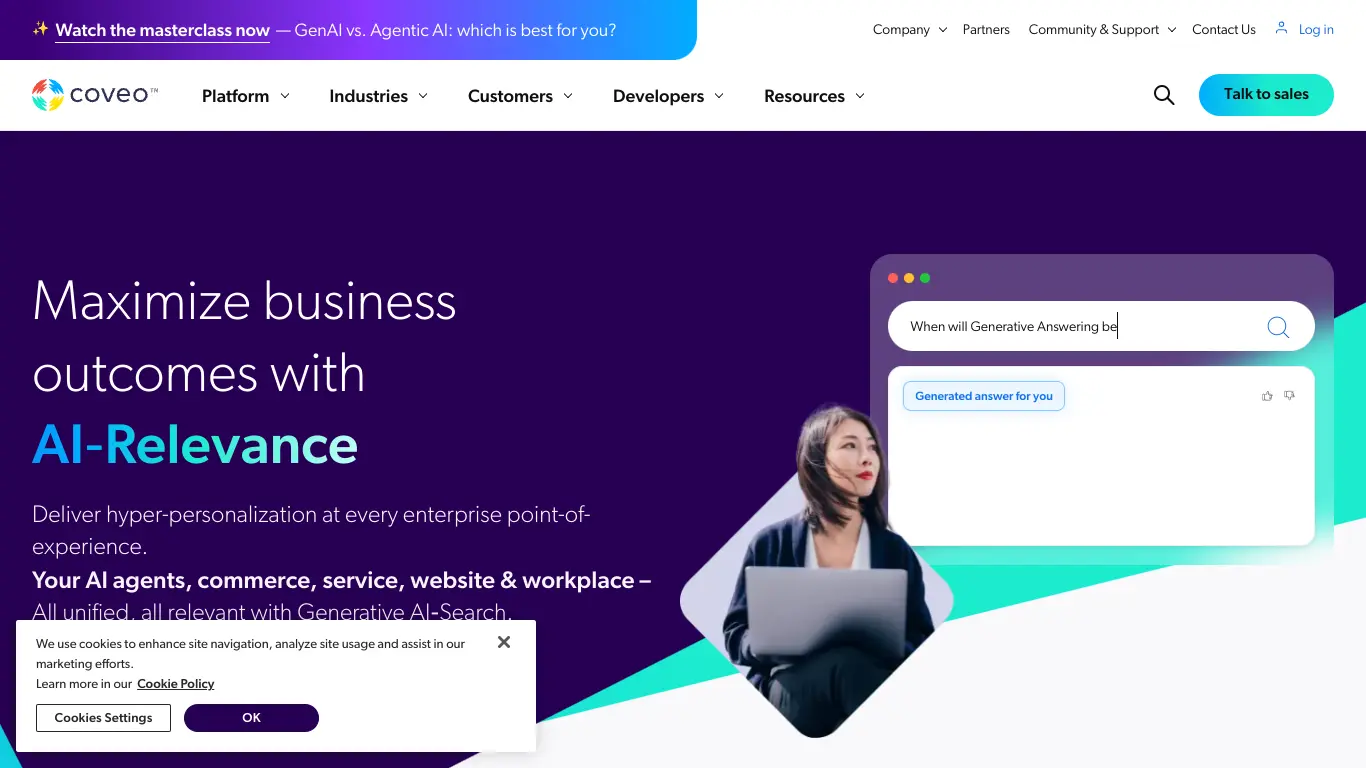
Introduction to Coveo
Are you struggling with information overload in your organization? Searching for the right document takes too long, customer service reps can’t find answers quickly, or your ecommerce site isn’t delivering personalized experiences? These challenges directly impact productivity, customer satisfaction, and ultimately your bottom line. The ability to connect people with relevant information at the right moment has become a critical competitive advantage in today’s digital landscape.
Coveo’s AI-powered platform might be the solution you’re looking for. Let’s dive deep into what Coveo offers and how it can transform your business’s information discovery and customer experience.
What is Coveo and its Purpose?
Coveo is an enterprise AI-powered relevance platform that combines unified search, analytics, and machine learning to deliver highly relevant information and personalized digital experiences. Unlike traditional search solutions, Coveo connects content from disparate sources across an organization and uses AI to understand context, intent, and user behavior to surface the most relevant information.
The platform’s core purpose is to solve the “relevance gap”—the disconnect between the vast amounts of information available in organizations and the ability of users (whether employees or customers) to find exactly what they need when they need it. By making information more discoverable and experiences more personalized, Coveo aims to improve digital experiences, increase workplace productivity, and drive business outcomes.
Who is Coveo Designed For?
Coveo serves multiple industries and use cases but is primarily designed for:
- Enterprise Organizations – Particularly mid-to-large companies with complex information ecosystems and digital touchpoints
- Ecommerce Businesses – Online retailers looking to enhance product discovery and personalization
- Customer Service Teams – Support centers seeking to improve agent efficiency and self-service options
- Workplace Knowledge Management – Companies needing better internal knowledge sharing and employee experience
- Website & Digital Experience Managers – Teams responsible for optimizing website experiences and conversion
The platform is especially valuable for organizations with:
- Large volumes of content across multiple repositories
- Complex product catalogs
- High support query volumes
- Multiple digital touchpoints requiring personalization
Getting Started with Coveo: How to Use It
Getting started with Coveo involves several key steps:
- Assessment and Planning: The process begins with identifying your organization’s specific use cases and goals. Coveo’s solutions team often works with new customers to map out implementation strategy.
- Content Unification: Connect Coveo to your organization’s various content sources—whether they’re knowledge bases, product catalogs, CRM systems, community forums, or enterprise applications. Coveo offers over 50 pre-built connectors.
- Implementation: Depending on your needs, implementation can range from using pre-built components for common platforms (like Salesforce, Sitecore, or Commerce platforms) to custom implementations using Coveo’s APIs and development tools.
- Configuration: Set up relevance tuning, search interfaces, query pipelines, and machine learning models to match your business needs.
- Training and Optimization: Train administrative staff on the Coveo platform and continuously optimize using Coveo’s analytics and machine learning capabilities.
For developers and technical teams, Coveo provides comprehensive documentation at docs.coveo.com, including guides, API references, and implementation samples. The platform offers both cloud-based solutions and integration options that work with your existing technology stack.
Coveo’s Key Features and Benefits
Core Functionalities of Coveo
🔍 Unified Intelligent Search
- Connects content from 50+ enterprise systems and repositories
- Delivers unified search experiences across multiple channels
- Provides advanced query understanding with natural language processing
- Offers machine learning-driven relevance ranking
🧩 Content Unification and Processing
- Indexes content from disparate sources into a unified index
- Normalizes data from different systems for consistent search experiences
- Provides real-time indexing and security trimming
- Offers content enrichment with AI-driven tagging and classification
🤖 Machine Learning and AI Capabilities
- Automatic relevance tuning based on user behavior
- Personalization based on user history and segments
- Query suggestions and auto-completion
- Automatic recommendation of related content
📊 Analytics and Insights
- Comprehensive search analytics dashboard
- User journey tracking and analysis
- Content gap identification
- A/B testing capabilities for search optimizations
🛠️ Development Tools and Integration Options
- JavaScript UI framework for custom search interfaces
- Comprehensive API suite for developers
- Pre-built connectors for common enterprise platforms
- Implementation options for headless commerce
Advantages of Using Coveo
- Improved Customer Experience
- 63% of customers now expect personalization as a standard service
- Coveo customers report up to 40% improvement in conversion rates
- Average 15-35% reduction in support case creation due to better self-service
- Enhanced Workplace Productivity
- Employees spend 30% of workday searching for information on average
- Coveo customers report 25% reduction in time spent searching for information
- Up to 20% reduction in employee onboarding time
- Revenue Growth
- Average 19% increase in order value with personalized recommendations
- 35% increase in cross-sell and upsell opportunities
- Improved product discovery leading to lower bounce rates
- Operational Efficiency
- Reduced support costs through improved self-service
- Decreased customer service agent training time
- Lower content management overhead
- Continuous Improvement
- AI-driven models that continuously learn and improve
- Actionable insights to guide content strategy
- Automatic optimization of relevance based on user behavior
Main Use Cases and Applications
Ecommerce Search and Recommendations
Coveo transforms online shopping by delivering personalized product search and recommendations. The platform analyzes shopper behavior, preferences, and context to surface the most relevant products, boosting conversion rates and average order values. Major retailers use Coveo to create Amazon-like shopping experiences with features like dynamic faceting, product recommendations, and personalized search results.
Customer Self-Service and Support
For customer service applications, Coveo helps organizations improve both self-service and agent-assisted support. The platform can be integrated with customer portals and knowledge bases to deliver contextual answers to customer questions. When integrated with service desks like Salesforce Service Cloud, Coveo provides agents with AI-powered recommendations of relevant articles and case resolutions, reducing handle time and improving first-call resolution rates.
Employee Experience and Knowledge Management
Within organizations, Coveo connects disparate knowledge repositories (SharePoint, Google Drive, Confluence, etc.) to create unified search experiences for employees. This reduces time spent searching for information, speeds up onboarding, and improves collaboration. The platform’s machine learning capabilities ensure that the most relevant content is surfaced based on the employee’s role, previous searches, and content usage patterns.
Website Search and Content Discovery
For content-rich websites, Coveo enhances discoverability by understanding user intent and delivering personalized content experiences. This is particularly valuable for media companies, educational institutions, and organizations with large document libraries. The platform can analyze content consumption patterns to automatically recommend related articles, videos, or resources.
Exploring Coveo’s Platform and Interface
User Interface and User Experience
Coveo’s platform is designed with different user interfaces for distinct audiences:
For End Users (Searchers)
The search experience can be fully customized to match your brand and website design, but typically includes:
- A prominent search box with query suggestions
- Faceted navigation for filtering results
- Tabbed interfaces for different content types
- Rich result templates showing content previews
- Recommendation components for related content
These interfaces are responsive and work across desktop and mobile devices. The search experience is designed to be intuitive and fast, with results appearing as the user types (instant results) and refinements happening in real-time.
For Administrators and Analysts
The Coveo Administration Console provides:
- A dashboard showing key search analytics
- Tools for managing sources and content
- Query pipeline management for tuning relevance
- Machine learning model management
- User and permission management
The interface uses modern web design principles with clear navigation, contextual help, and data visualizations that make it accessible for both technical and business users.
For Developers
Developers work with Coveo through:
- The Coveo JavaScript Framework for UI development
- REST APIs for custom integrations
- Admin APIs for programmatic platform management
- Documentation and code samples
Platform Accessibility
Coveo places significant emphasis on platform accessibility:
Technical Accessibility
- Cloud-based platform accessible via web browsers
- Mobile-responsive components and interfaces
- API-first architecture allowing for headless implementations
- Support for major browsers and devices
Usability Accessibility
- Compliance with WCAG 2.1 guidelines for accessible design
- Screen reader compatibility
- Keyboard navigation support
- Color contrast options for visibility
Language and Localization
- Multi-language support for both interface and content
- UTF-8 character support for global alphabets
- Machine learning models that work across languages
- Interface localization options
Coveo Pricing and Plans
Subscription Options
Coveo offers several pricing tiers based on use case, scale, and functionality needs:
| Plan | Best For | Key Features | Approximate Price Range* |
|---|---|---|---|
| Pro | Small to medium businesses | Core search functionality, basic personalization, standard analytics | Starting at $3,000/month |
| Enterprise | Large organizations | Advanced ML capabilities, full personalization suite, comprehensive analytics, premium support | Starting at $10,000/month |
| Commerce | Online retailers | Specialized ecommerce features, product recommendations, commerce analytics | Custom pricing |
| Service | Customer support teams | Case deflection, agent assistance, knowledge management | Custom pricing |
| Workplace | Internal employee experience | Enterprise connectors, secure search, workplace analytics | Custom pricing |
*Note: Exact pricing depends on factors like number of users, query volume, content volume, and specific feature requirements. Coveo operates on an annual subscription model with custom pricing for enterprise needs.
Free vs. Paid Features
Free Options:
- Developer sandbox environments for testing
- Documentation and knowledge base access
- Basic community support
- Limited-time proof of concept implementations
Paid Features (Varies by Plan):
- Full production deployment capabilities
- Advanced machine learning models
- Enterprise security features
- Premium support and service levels
- Implementation and strategy services
- Advanced analytics and insights
- Custom model training and tuning
- Integration with premium enterprise systems
Coveo’s pricing scales based on several factors including:
- Number of searchable documents
- Monthly query volume
- Number of content sources connected
- Specific AI and ML capabilities required
- Implementation support needs
For precise pricing, potential customers need to contact Coveo directly for a customized quote based on their specific requirements.
Coveo Reviews and User Feedback
Pros and Cons of Coveo
👍 Pros
- Advanced AI and ML Capabilities
- Users consistently praise the machine learning-driven relevance
- Automatic tuning reduces administrative overhead
- Personalization features deliver measurable business results
- Unified Search Experience
- The ability to search across disparate systems is highly valued
- Security trimming ensures users only see what they’re allowed to access
- Consistent experience across different content types
- Analytics and Insights
- Detailed search analytics provide actionable business intelligence
- Content gap analysis helps improve knowledge management
- User behavior tracking enables continuous optimization
- Platform Flexibility
- Extensive API capabilities allow for custom implementations
- Pre-built components speed up deployment
- Works with existing technology investments
- Support and Customer Success
- Professional services team receives high marks
- Comprehensive documentation and training resources
- Active community of users and developers
👎 Cons
- Implementation Complexity
- Full platform implementation can be resource-intensive
- May require specialized skills for advanced customization
- Initial configuration can be challenging for new users
- Cost Considerations
- Premium pricing may be prohibitive for smaller organizations
- Some features only available in higher-tier plans
- ROI may take time to realize for certain use cases
- Learning Curve
- Administrative interface has many options that take time to master
- Understanding ML concepts requires some training
- Query pipeline management can be complex
- Integration Challenges
- Some legacy systems require custom connector development
- Security configuration across multiple systems can be complex
- Performance can vary based on source system capabilities
User Testimonials and Opinions
From G2, Gartner Peer Insights, and other review platforms, Coveo maintains strong ratings, typically between 4.3-4.6 out of 5 stars. Here are some representative testimonials:
“Coveo has transformed our customer self-service capabilities. After implementation, we saw a 32% reduction in case creation and significantly higher satisfaction scores. The machine learning continuously improves the experience without requiring constant tuning.” – Director of Customer Experience, Enterprise Technology Company
“The commerce search and recommendations have delivered measurable results for our online store. Our average order value increased by 23% after implementing personalized recommendations, and customers are finding products faster with the intelligent search capabilities.” – Ecommerce Manager, Retail Organization
“Implementation was more complex than initially expected, but the end result was worth it. Our employees now save approximately 7 hours per week that was previously spent searching across different systems for information.” – Knowledge Management Lead, Financial Services
“The analytics capabilities provide insights we never had before about what our customers are looking for and whether they’re finding it. This has guided our content strategy and helped us improve conversion rates significantly.” – Digital Marketing Director, Manufacturing
An analysis of user feedback shows particular strengths in relevance quality, machine learning capabilities, and the unified search experience. Areas sometimes mentioned for improvement include simplifying the administration interface and providing more self-service implementation options for smaller organizations.
Coveo Company and Background Information
About the Company Behind Coveo
Coveo was founded in 2005 in Quebec City, Canada, by Louis Têtu (Chairman and CEO), Laurent Simoneau (President and CTO), and other search technology experts. The company has grown from its roots as an enterprise search provider to become a leader in AI-powered relevance platforms.
Key Company Milestones:
- 2005: Founded in Quebec City, Canada
- 2008: Initial focus on enterprise search technology
- 2011: Pivot to cloud-based solutions
- 2015: Introduction of machine learning capabilities
- 2018: $100M investment round led by Evergreen Coast Capital
- 2019: Acquisition of Tooso, an AI-based commerce engine
- 2021: Initial public offering on the Toronto Stock Exchange (TSX: CVO)
- 2022: Named a Leader in the Gartner Magic Quadrant for Insight Engines
Company Scale:
- 750+ employees globally
- Offices in Quebec City, Montreal, San Francisco, London, Amsterdam, and Tokyo
- 600+ enterprise customers across 50+ countries
- Public company traded on Toronto Stock Exchange (TSX: CVO)
Coveo has established itself as a thought leader in enterprise search, relevance, and machine learning, publishing extensive research and hosting the annual Relevance 360 conference. The company maintains strong technology partnerships with major platforms like Salesforce, ServiceNow, Sitecore, and Adobe.
Coveo Alternatives and Competitors
Top Coveo Alternatives in the Market
- Algolia (https://www.algolia.com/)
- Developer-friendly search API
- Strong in ecommerce and mobile app search
- More focused on search than broader relevance platform
- Elasticsearch/Elastic (https://www.elastic.co/)
- Open-source search and analytics engine
- Strong in log analytics and application search
- Requires more technical expertise to implement
- Lucidworks Fusion (https://lucidworks.com/)
- Enterprise search platform with AI capabilities
- Strong in knowledge management applications
- Similar enterprise focus to Coveo
- SearchUnify (https://www.searchunify.com/)
- AI-powered search for customer support
- Focused specifically on support use cases
- Less emphasis on commerce applications
- Bloomreach Discovery (https://www.bloomreach.com/en/products/discovery)
- Commerce-specific search and merchandising
- Strong product recommendation capabilities
- Less focused on knowledge management use cases
Coveo vs. Competitors: A Comparative Analysis
| Feature/Aspect | Coveo | Algolia | Elasticsearch | Lucidworks Fusion | SearchUnify |
|---|---|---|---|---|---|
| Core Strength | Unified relevance platform | Developer-friendly search API | Versatile search & analytics engine | Search application platform | Support-focused search |
| ML Capabilities | Extensive built-in ML models | Basic ML with custom options | Limited out-of-box ML | Strong ML capabilities | Support-specific ML |
| Ease of Implementation | Moderate to complex | Developer-friendly | Complex | Moderate to complex | Moderate |
| Commerce Focus | Strong | Strong | Limited | Moderate | Limited |
| Knowledge Management | Strong | Limited | Moderate | Strong | Strong |
| Pricing Model | Enterprise subscription | Usage-based | Open source + paid features | Enterprise subscription | Subscription |
| Target Market | Enterprise | SMB to Enterprise | Technical organizations | Enterprise | Support-focused organizations |
Differentiating Factors:
Coveo distinguishes itself through:
- The breadth of its unified platform that handles search, recommendations, and personalization
- Advanced machine learning capabilities that require minimal manual tuning
- Pre-built integrations with major enterprise platforms
- Strong analytics capabilities that provide business insights
- Focus on the entire relevance journey rather than just search functionality
Different solutions may be more appropriate depending on specific requirements:
- For developer-led projects with API-first needs: Algolia may be preferable
- For organizations with strong technical teams and budget constraints: Elasticsearch
- For pure commerce search and merchandising: Bloomreach may be more specialized
- For customer support-specific applications: SearchUnify offers targeted functionality
Coveo Website Traffic and Analytics
Website Visit Over Time
According to data from web analytics platforms, Coveo.com has shown steady growth in website traffic, reflecting the increasing interest in AI-powered search and relevance solutions:
| Time Period | Monthly Visitors (Approx.) | Year-over-Year Growth |
|---|---|---|
| 2022 Q4 | 175,000 – 195,000 | +18% |
| 2023 Q1 | 180,000 – 200,000 | +15% |
| 2023 Q2 | 190,000 – 210,000 | +12% |
| 2023 Q3 | 200,000 – 220,000 | +14% |
*Note: These figures are approximations based on publicly available data and industry analytics tools.
The traffic patterns show seasonal fluctuations, with peaks often corresponding to major product announcements and the company’s annual Relevance 360 conference.
Geographical Distribution of Users
Coveo’s website attracts a global audience, with visitors concentrated in regions where the company has established market presence:
- North America: ~55% (primarily US and Canada)
- Europe: ~30% (with strong presence in UK, France, Germany)
- Asia-Pacific: ~10% (growing presence in Japan and Australia)
- Rest of World: ~5%
The geographic distribution aligns with Coveo’s global office locations and enterprise customer base, with particularly strong engagement from technology hubs and regions with high concentrations of enterprise businesses.
Main Traffic Sources
Coveo’s website traffic comes from diverse channels:
- Organic Search (40-45%): Strong SEO performance for terms related to enterprise search, AI relevance, and industry-specific solutions.
- Direct Traffic (25-30%): Indicates strong brand recognition among target audiences.
- Referral Traffic (15-20%): Primarily from technology partners, industry publications, and customer websites.
- Paid Search/Social (10-15%): Strategic campaigns targeting enterprise decision-makers.
- Email Marketing (5-10%): Regular communication with prospects and customers.
The high proportion of organic and direct traffic suggests Coveo has established thought leadership in its space, while the diverse channel mix indicates a comprehensive digital marketing strategy.
Frequently Asked Questions about Coveo (FAQs)
General Questions about Coveo
Q: What makes Coveo different from traditional search solutions?
A: Unlike traditional search, Coveo combines unified search across multiple sources with AI and machine learning to deliver personalized relevance. The platform continuously learns from user interactions to improve results without manual tuning, making it more adaptive than keyword-based search tools.
Q: Is Coveo only for large enterprises?
A: While Coveo has strong adoption among large enterprises, the company offers solutions scaled for mid-sized organizations as well. The best fit typically depends on the complexity of your information landscape and specific use cases rather than company size alone.
Q: How long does implementation typically take?
A: Implementation timelines vary based on complexity. Basic implementations can be completed in 4-8 weeks, while more complex enterprise-wide deployments may take 3-6 months. Coveo offers implementation services and partners with system integrators to accelerate deployment.
Feature Specific Questions
Q: Does Coveo support multiple languages?
A: Yes, Coveo supports 50+ languages with capabilities including language detection, linguistic analysis, and language-specific relevance tuning. The platform can handle multi-language content repositories and provide appropriate results based on the user’s language context.
Q: Can Coveo connect to custom or proprietary systems?
A: Yes, beyond the 50+ pre-built connectors, Coveo offers a Push API and custom connector framework that allows integration with virtually any system that exposes an API. Custom connectors can be developed by Coveo’s professional services team or by customers with development resources.
Q: How does Coveo’s machine learning work?
A: Coveo’s machine learning models analyze user interactions (clicks, queries, case resolutions, etc.) to understand which content is most relevant for specific contexts. The system automatically adjusts relevance ranking based on these patterns, becoming more accurate over time without manual tuning.
Pricing and Subscription FAQs
Q: Is there a free trial available for Coveo?
A: Coveo typically doesn’t offer a standard free trial but provides proof of concept implementations for qualified prospects. These limited-time implementations allow organizations to validate the platform’s capabilities with their own content and use cases.
Q: How is Coveo priced?
A: Coveo uses a subscription model with pricing based on factors including number of searchable documents, monthly query volume, number of users, and specific features required. Pricing starts at approximately $3,000/month for basic implementations and scales for enterprise deployments.
Q: What’s included in a typical subscription?
A: Subscriptions typically include the core platform, selected connectors, analytics, a defined query volume, cloud hosting, standard support, and regular platform updates. Professional services, premium support, and certain advanced features may require additional investment.
Support and Help FAQs
Q: What support options does Coveo provide?
A: Coveo offers tiered support options including:
- Standard support with business hours coverage
- Premium support with extended hours and faster response times
- Platinum support with 24/7 coverage and dedicated support resources
All customers have access to Coveo’s knowledge base, community forums, and documentation.
Q: Is training available for Coveo administrators?
A: Yes, Coveo provides both self-service and instructor-led training options. The Coveo Academy offers online courses covering administration, development, and implementation. Custom training programs are available for enterprise customers.
Q: What resources are available for developers?
A: Developers can access comprehensive documentation at docs.coveo.com, including API references, implementation guides, and code samples. Coveo also provides developer sandboxes, GitHub repositories with sample code, and developer community forums.
Conclusion: Is Coveo Worth It?
Summary of Coveo’s Strengths and Weaknesses
Strengths:
- Industry-leading AI and machine learning capabilities that continuously improve relevance
- Unified platform that connects disparate content sources into a seamless experience
- Strong analytics providing actionable insights about content and user behavior
- Flexible implementation options from pre-built components to fully custom solutions
- Proven ROI metrics across customer experience, employee productivity, and revenue growth
Weaknesses:
- Higher price point that may be challenging for smaller organizations to justify
- Implementation complexity requiring dedicated resources or professional services
- Learning curve for administrators to fully leverage all platform capabilities
- Some advanced features only available in higher-tier plans
- May be more sophisticated than needed for simple search use cases
Final Recommendation and Verdict
Coveo represents a significant investment in both budget and implementation resources, but for organizations facing complex information challenges, the platform delivers substantial value. The ROI comes from multiple areas: improved customer self-service reducing support costs, enhanced employee productivity through better knowledge access, and increased revenue through personalized commerce experiences.
Coveo is likely worth the investment if:
- Your organization has content spread across multiple repositories that users struggle to navigate
- You’re looking to deliver personalized digital experiences at scale
- Your current search solution doesn’t understand user intent or learn from interactions
- You have specific KPIs around case deflection, conversion rates, or employee productivity
- You value a platform that continually improves without constant manual tuning
You might consider alternatives if:
- You need a simple search solution for a single website or application
- Your organization lacks the resources for a comprehensive implementation
- You have limited content sources that don’t require unified search
- Budget constraints make enterprise pricing challenging
For organizations with the right use cases and implementation resources, Coveo consistently delivers measurable business outcomes that justify the investment. The platform’s continuous learning and optimization capabilities mean that value increases over time as the AI models become more refined.
As digital experiences become increasingly central to business success, tools like Coveo that connect people with relevant information at the right moment will continue to be critical competitive differentiators.